


“They take our jobs and increase crime”: Anti-immigrant narrative spread without evidence
The growing number of foreign nationals with residence permits in Albania was portrayed on social media and in the media as a threat to Albanian workers’ jobs and a source of crime. Official data confirm this increase but provide no evidence that their arrival has led to lower wages, the replacement of Albanian workers or a rise in crime.
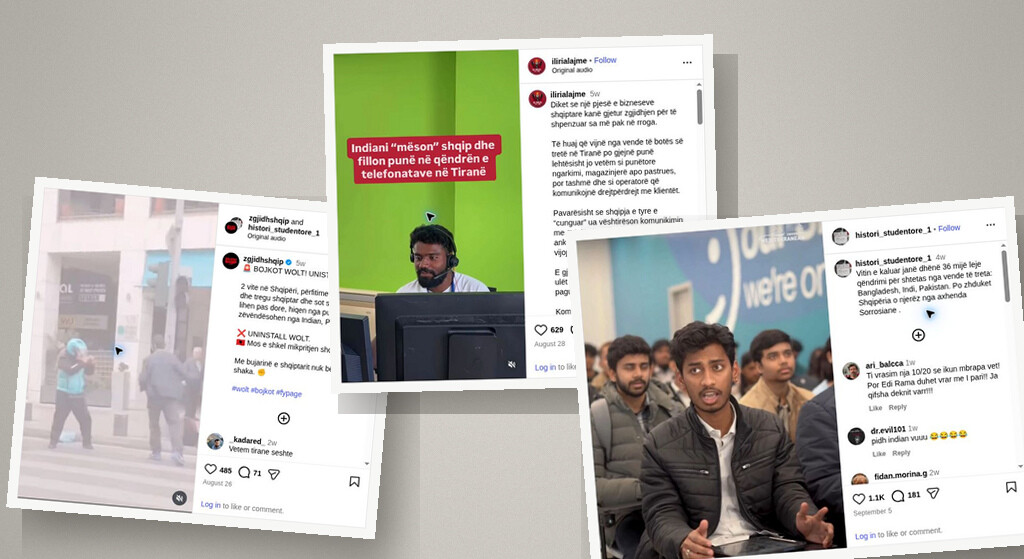
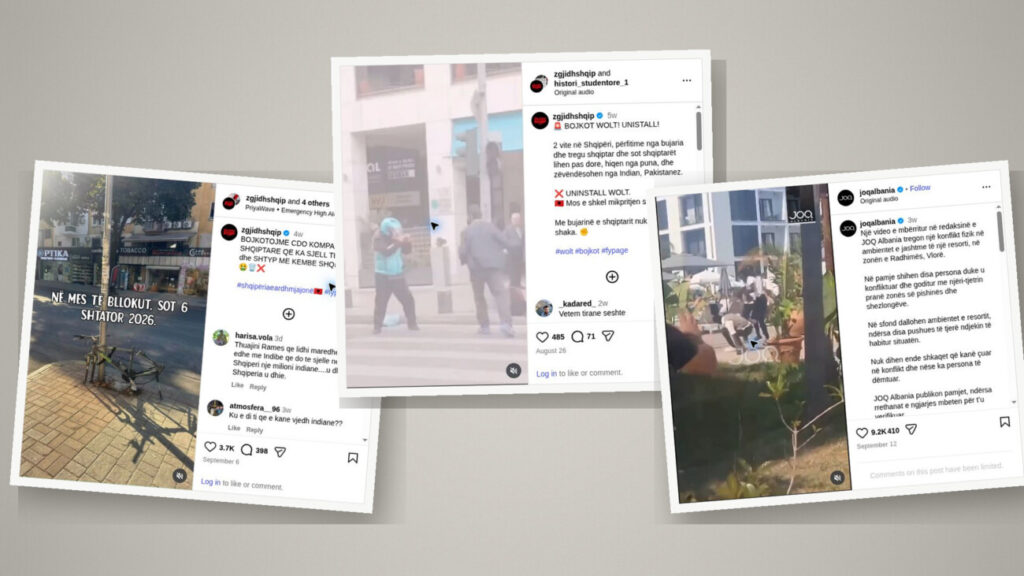
Illustrative graphic featuring social media posts. Graphic by Media Amfora
“Are foreign immigrants becoming a problem in our country?” was the headline of a report in which the online newspaper “Shekulli” brought together three incidents involving Indian nationals in a single article in August, including an attempted theft in Tirana, the theft of a mobile phone and the alleged filming of women and girls in Durrës.
By presenting these incidents together, the article raised the question of whether foreign immigrants were becoming a problem for the country, linking the behaviour of a few individuals to difficulties with integration. Although it provided no statistical evidence that these cases reflected a wider problem of crime among immigrants, a broader narrative gained momentum throughout September, with videos featuring workers, mainly from India, portraying them as a source of economic problems and crime.
On 24 August, the Institute of Statistics (INSTAT) reported that Albania had 32,163 foreign nationals with residence permits at the end of 2025, an increase of 46.6% compared with the previous year, while employment was the main reason for 55.1% of the permits issued.
The data document an increase in the number of foreign nationals working in Albania but do not show that Albanians have lost their jobs to foreign workers or provide a comparison of wages between the two groups.
Klodian Muço, a professor and researcher, linked this trend to the shortage of domestic labour.
“I do not see the arrival of foreign workers as an economic or social threat. On the contrary, I see it as an opportunity for Albanian businesses,” Muço told Amfora.al.
Robert Gajda, a law lecturer at the University of Elbasan, challenged the generalisation of one person’s actions to others of the same background.
“It is always wrong to generalise about an entire ethnic or national group based on a negative or criminal incident that may have occurred,” Gajda told Amfora.al.
On 6 September, the labour market narrative escalated into calls for a boycott. “We boycott every anti-Albanian company that has brought in foreigners and tramples on Albanians,” read a post by the Instagram account “Zgjidh Shqip”. On Facebook, the page describes itself as an online media outlet. Although the post received around 3,700 likes and more than 400 comments, it did not identify any companies or Albanian workers who had been replaced.
Meanwhile, on 12 September, the JOQ Albania account published a video of a confrontation at a resort in Radhimë, with the headline: “Africans have had enough in Albania. A fight breaks out among them.” Although the circumstances were unknown, the individuals’ origins were inferred from their appearance. By 7 October, the video had received around 9,200 likes and 410 comments, including racist remarks and calls for their forcible removal.
INSTAT statistics show a 17.4% increase in criminal offences during 2025 but do not identify the nationalities of suspected perpetrators. Nor do these data attribute the rise in crime in Albania to foreign nationals.
Foreign workers portrayed as “replacements” for Albanians
In late August, a wave of videos calling for boycotts began circulating on social media and continues to this day, urging people to boycott companies that, according to the posts, were replacing Albanian workers with foreign nationals.
On 26 August, the accounts “Zgjidh Shqip” and “Histori Studentore” published a video on Instagram showing a man arguing with an employee of the delivery company “Wolt”. The footage carried the caption “What is happening in Tirana?”, while followers were urged to stop placing orders and delete the app.
“2 years in Albania, benefiting from Albanian generosity and the Albanian market, and today Albanians are neglected, dismissed from their jobs and replaced by Indians and Pakistanis,” the post read.
However, the footage was not recorded in Tirana but in Athens, where the name “Athens Tiare”, a hotel in Omonia Square, was visible in the background. The video did not identify those involved or the cause of the confrontation and showed no Albanian involved in the incident.
Two days later, “Iliria Lajme” published an Instagram post showing a man wearing headphones in a call centre, accompanied by the caption: “Indian ‘learns’ Albanian and starts working in a call centre in Tirana.” The text claimed that businesses were hiring foreigners to reduce costs. “They are paid less than Albanians,” it stated, without identifying the man, the call centre or any specific case.
On 5 September, “Histori Studentore” claimed in a post that 36,000 residence permits had been issued during the year to nationals from Bangladesh, India and Pakistan, warning that Albania was “disappearing”. No source was provided for the figure, while INSTAT reported 32,163 foreign nationals holding residence permits at the end of 2025, not 36,000 newly issued permits. Kosovo and Italy were the leading countries of origin, followed by India and the Philippines.
According to economist Klodian Muço, the claim that foreign workers are replacing Albanians does not reflect the economic reality created by their employment in the country.
“Recruiting workers from abroad is not replacing Albanians or lowering wages. On the contrary, the opposite is happening,” he said.
Muço explained that employers often provide food and accommodation for workers arriving from abroad, in addition to their wages.
“For several reasons, a foreign worker costs more than a domestic worker,” he said.
Comparing around 26,000 foreign workers with 1.2 million people in employment, Muço assessed that they currently account for a small share of the labour market. Robert Gajda, meanwhile, distinguished concerns about domestic employment from blaming foreign workers, describing them as two separate issues.
“There is nothing inherently wrong with calling for greater attention from the authorities to the employment of Albanians, but doing so by portraying the foreign workforce negatively is unfair,” he said.
The Commissioner for Protection from Discrimination, asked by Amfora.al about calls to boycott companies employing foreign nationals, explained that such matters are assessed according to the circumstances of each case. Without referring to the specific posts examined in this analysis, the institution explained that calls for boycotts solely because companies employ foreign nationals may raise concerns about incitement to discrimination in employment, particularly when they seek to influence employers not to hire or to exclude people because of their origin or nationality.
“Legal assessments are carried out on a case-by-case basis, in accordance with anti-discrimination legislation and labour law,” the Commissioner explained.
Isolated incidents turned into accusations against foreign nationals
On 2 October, “Zgjidh Shqip” and “Histori Studentore” published an Instagram video captioned: “Indian burger thief in Tirana”. The courier in the footage appeared to be eating food he was supposed to deliver to a customer, while the post raised concerns about food safety and called for a boycott of “Wolt”.
However, the video had been published on 26 October 2025 by a TikTok account, whose description placed the incident in Tbilisi, Georgia. Footage that had been circulating for almost a year was thus presented as a consumer safety problem in Tirana.
Ten days earlier, the same accounts had published another video showing a courier relieving himself at the entrance to a building. He was portrayed as an Indian national working in Albania, and the incident was used to call for inspections, boycotts and the employment of more Albanians.
This incident had not taken place in Albania either. The footage had appeared in a post from Georgia on 28 September 2025, with the description placing it in Tbilisi on 22 September. The individual was wearing a helmet, and there was no evidence establishing his nationality.
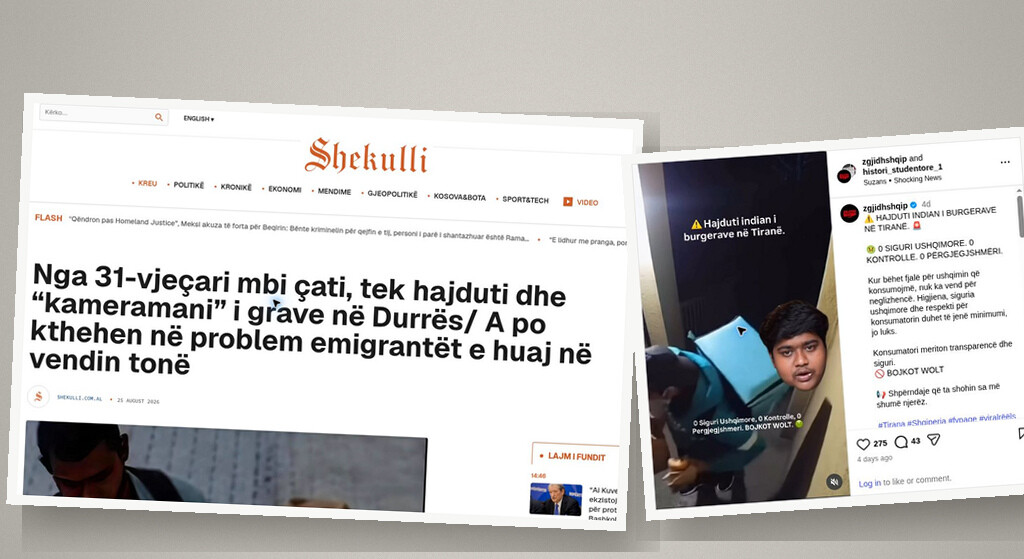
“Wolt” is a digital platform for ordering and delivering food and products from businesses to customers. The footage carried the caption “What is happening in Tirana?”, while followers were urged to stop ordering from the company and delete the app.
Earlier, “Shekulli” had reported on a 31-year-old arrested in Kombinat on suspicion of attempted theft, footage in which an Indian national allegedly took a mobile phone from an elderly person in Durrës, and allegations that another individual had filmed women. “Versus Albania” reported that police had taken the latter individual in for questioning, without providing details of any subsequent action.
“Shekulli” acknowledged that many Indian nationals integrate without causing problems but linked the incidents to employment difficulties, without establishing whether the individuals involved were workers or whether those circumstances had any connection to the reported actions.
For Gajda, the problem lies not only in mentioning nationality but also in the imbalance created when foreign nationals are portrayed primarily through negative incidents.
“If reporting on foreigners focuses only on criminal or negative aspects, it will naturally create a negative impression of them,” he said.
According to him, prejudice is more pronounced towards people of Asian or African origin. “Thus, a German and a Bangladeshi are both foreigners, but they are not perceived in the same way,” Gajda said.
Regarding media coverage of criminal incidents involving foreign nationals, the Commissioner for Protection from Discrimination explained that the problem arises when individuals’ actions are used to generalise about an entire community. The institution provided an assessment of reporting principles without referring to specific cases.
“The problem lies not in reporting the facts, but in turning an individual fact into an attribute of an entire group,” the Commissioner emphasised.
Individual incidents, footage taken from one country and presented as occurring in another, and unverified nationalities were used to construct a collective threat, without evidence showing that foreign nationals were more involved in crime.