


Poland’s Institutional Crisis Misrepresented as a “Coup”
The dispute over the leadership of Poland’s Constitutional Tribunal was portrayed as an attempted “coup d’état” across online media and social networks. In Albania, claims circulated that police had entered the court and that the prime minister was attempting to stage a coup. Meanwhile, international social media posts also accused the European Union, without evidence, of seeking to take control of Poland’s courts.
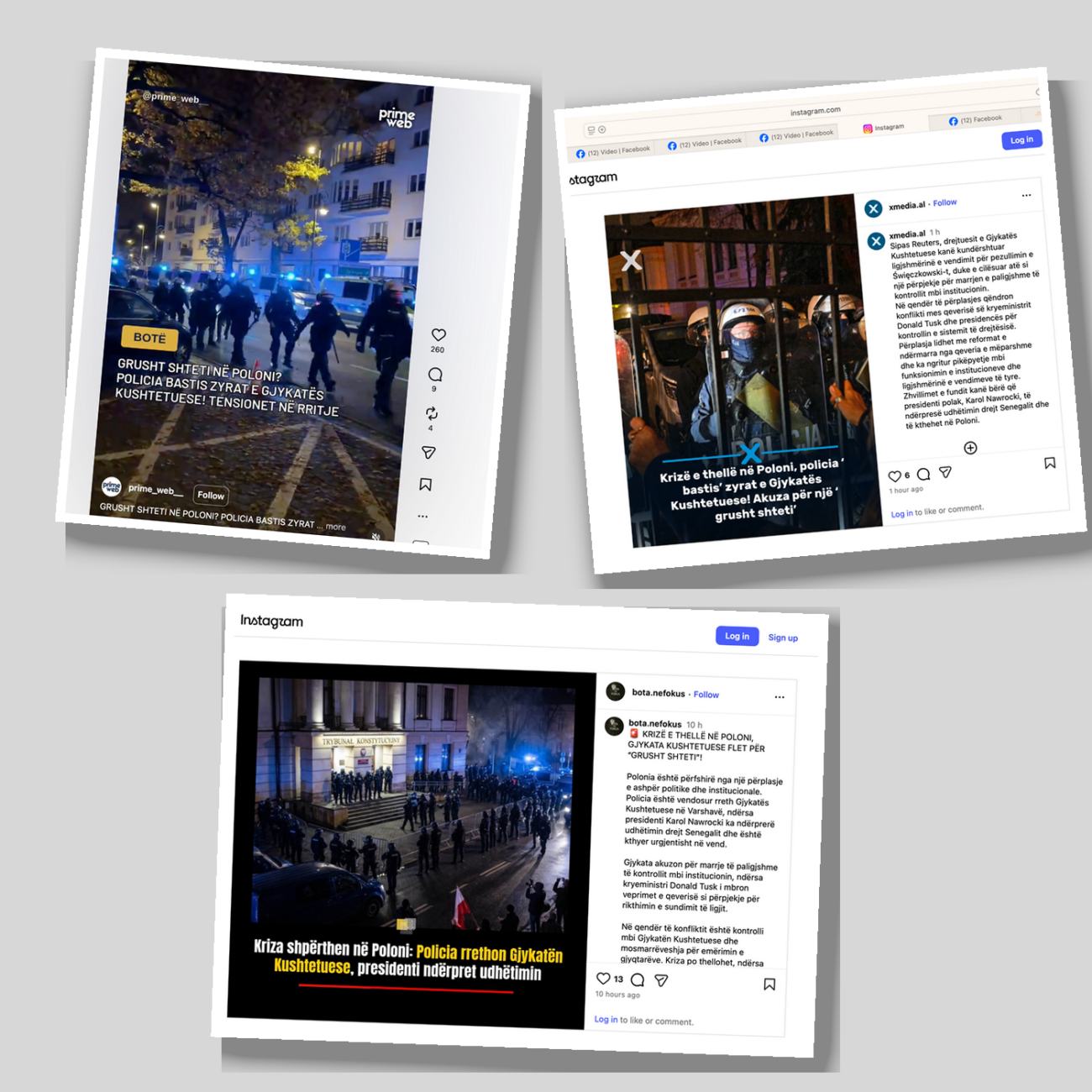
Illustrative graphic based on online media and social media posts. Prepared by Amfora Media.
A political crisis in Poland in late October was accompanied by protests and a confrontation over the leadership of the Constitutional Tribunal. Images of police officers near the institution circulated on social media, where several posts suggested that a coup was underway. In Albania, the developments were reported under headlines referring to a police raid on the court and escalating tensions.
“Coup in Poland? Police raid Constitutional Tribunal offices! Tensions rise,” the Instagram news page “Prime Web” reported, accompanying its post with footage of police officers in the streets.
However, Warsaw Police denied that officers had entered the court building in an official statement issued on October 30.
“We categorically emphasize that the Police are not inside the premises of the Constitutional Tribunal,” the institution stated in its announcement published on its official website.
According to Polish authorities, police had been called in to ensure security following requests from the Prosecutor General and a female judge of the Tribunal. Officers operated exclusively outside the building, where protesters had gathered. Police also reported detaining three individuals who had crossed the court’s perimeter fence.
Dozens of online media and social media posts began circulating on Friday evening, emphasizing the possibility of a coup despite the absence of circumstances supporting such a characterization. A coup d’état refers to the sudden and unlawful seizure of power, typically organized by a limited group of individuals within political or military structures, through the use or threat of force, with the aim of overthrowing a government and taking control of state institutions.
Poland is currently facing a dispute over the leadership and functioning of its Constitutional Tribunal. Prime Minister Donald Tusk’s government presents its judicial reforms as efforts to restore the rule of law, while its opponents question the legality of the government’s actions.
On Facebook, the page “IDEALISTI-al” portrayed Poland’s institutional crisis as an attempted “coup”, linking the developments to alleged United States involvement in the country’s political affairs. The post claimed that “the USA is removing Tusk” and suggested that Prime Minister Donald Tusk was no longer accepted by the Polish people. It further claimed that President Karol Nawrocki, described as a close friend of Donald Trump, would play a role in removing him from office.
The post concluded with the assertion that “Tusk must be removed, and he will be removed,” combining reporting on a real event with political opinions and unsupported claims about a potential change of government in Poland.
While the claim that the United States was involved in efforts to remove Prime Minister Tusk is not supported by evidence, US Ambassador to Poland Tom Rose described the situation as an unprecedented institutional confrontation in a statement on October 30 and called for restraint to prevent further escalation. He stressed that the United States should neither judge nor interfere in Poland’s internal affairs.
Nevertheless, the “IDEALISTI-al” post shifted attention away from the dispute over the Constitutional Tribunal’s leadership and towards a narrative of American intervention and the possible removal of the government, without providing sources to substantiate these claims.
Meanwhile, the Instagram page “Xmedia.al” reported the event under the headline: “Deep crisis in Poland, police ‘raid’ Constitutional Tribunal offices! Allegations of a ‘coup d’état’.”
The use of the term “raid” created the impression that police forces had entered the institution to conduct an operation. However, according to the official statement issued by Warsaw Police, officers had been deployed outside the court to maintain security and public order.
Similarly, “Newsmax Balkans Albania” published a video with the caption “Usurpation of power”, linking this characterization to the Polish president’s urgent return to Warsaw and the presence of police near the Constitutional Tribunal.
Although the description accompanying the video referred to the institutional crisis, protests, and confrontation between the government and opposition, the use of the phrase “usurpation of power” in the headline, without clearly identifying who was making the accusation, risked presenting a contested political interpretation as a confirmed factual development.
In another Instagram post, the page “Bota në fokus” used the headline: “Crisis erupts in Poland: Police surround Constitutional Tribunal, president cuts trip short.” The accompanying description stated that the court had referred to a “coup d’état”.
Unlike posts suggesting international interference or a raid on the institution, this report also included Prime Minister Donald Tusk’s position that the government’s actions were intended to restore the rule of law.
However, the general use of the term “the Court” when referring to allegations made by its contested leadership did not sufficiently clarify that the dispute concerned the legitimacy of the institution’s leadership.
An analysis of these publications by the Resilience Observatory at Amfora Media identified different ways in which the same event was presented, ranging from headlines exaggerating police actions to contested allegations of power usurpation and unsupported claims of American intervention.
The allegations of a coup did not originate with the protests. The head of the Constitutional Tribunal, Bogdan Święczkowski, had already referred to a “constitutional coup” on October 15, according to Polish Radio. However, this was an allegation made in the context of the institutional confrontation, rather than an established fact.
In another video, the news page “Prime” portrayed President Karol Nawrocki as the person who had stopped Prime Minister Tusk’s alleged coup attempt. Meanwhile, outside Albania, several English-language social media accounts also linked the developments to the European Union.
On Instagram, the political content account “The Chronicler Files” portrayed the events as an attempted coup and called for military intervention. Meanwhile, the Australian platform “The Adelaide Set” claimed that the EU wanted to control Poland’s courts in order to force the country to accept migrants and transform Europe into a “caliphate”.
However, official EU documents concerning funding and migration do not support this claim. They provide no evidence that the EU is seeking to take control of Poland’s courts to force the country to accept migrants.
This narrative was also amplified by Russia Today, a Russian state-controlled media outlet, which relayed accusations of an “illegal coup”, attributing them to President Nawrocki’s political camp.
Protests and the dispute surrounding Poland’s Constitutional Tribunal have recently dominated developments in the country. However, misleading narratives constructed the image of a coup d’état without sufficient factual evidence. The presence of police near the court does not demonstrate that a coup took place, while claims of an EU plan to control the institution and impose migration policies are not supported by the evidence examined.