


Algorithms change how news is distributed, posing a challenge for independent media
Social media has become one of the main channels through which people access information, while the algorithms used by these platforms influence which news stories receive greater visibility and which attract less attention. The challenges this dependence creates for independent journalism were discussed at the European Union’s Regional Media Conference for the Western Balkans, held in Serbia.
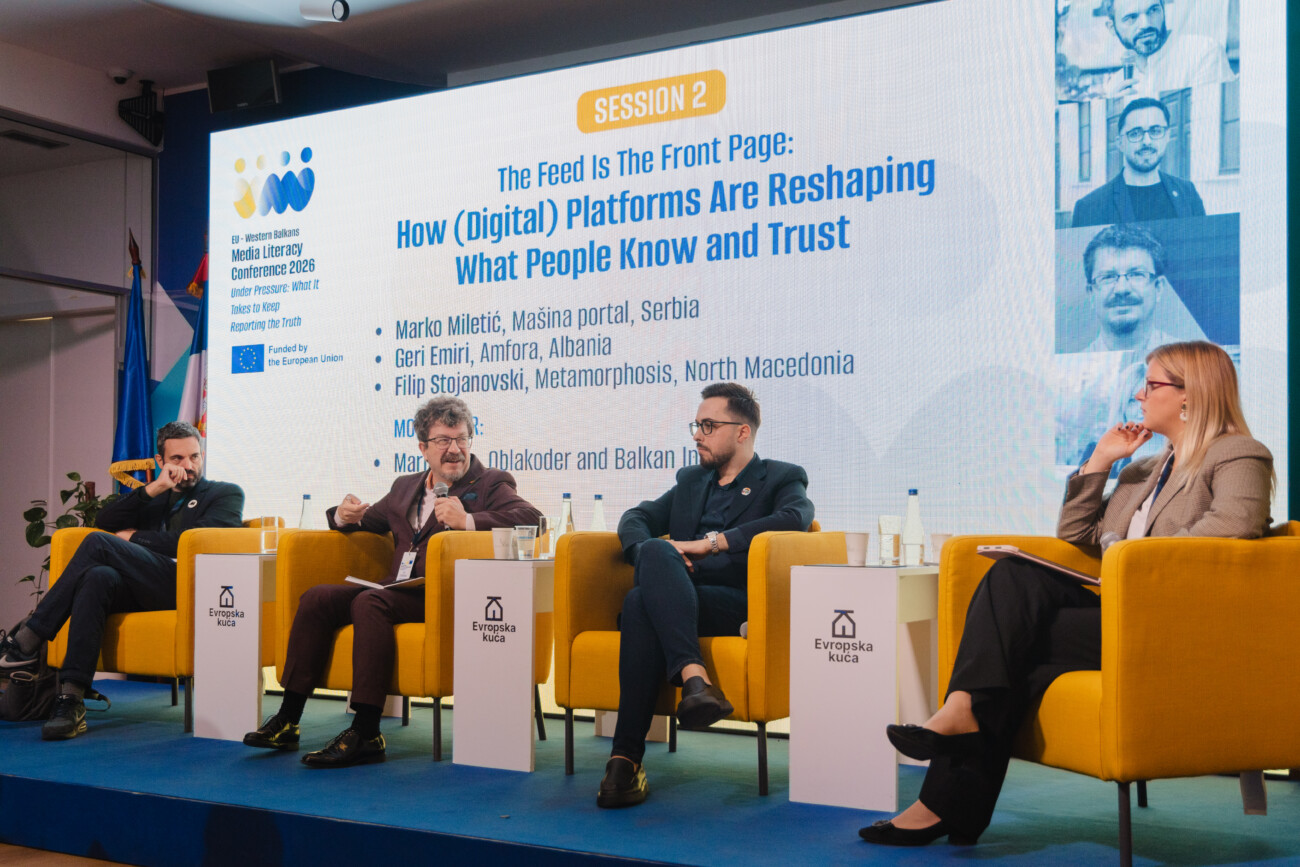
Participants in the panel on the impact of digital platforms on news distribution. Photo: Europe House Serbia.
On 7 October, the European Union’s Regional Media Conference for the Western Balkans was held in Belgrade, where journalists and researchers discussed the impact of social media on how audiences access information, as well as the challenges faced by reporters and media outlets across the region in their work.
During the panel dedicated to digital platforms, they discussed the difficulties small media outlets face in reaching readers while striving to maintain journalistic standards. Fewer and fewer people visit news organisations’ websites directly to read news. Instead, many get their information from posts appearing on social media, such as Facebook and similar platforms.
This means that newsrooms decide which stories to publish, but how those stories are distributed to users depends largely on the platforms’ algorithms.
“Today, we face algorithms and a feed of posts that changes every day, every week or every month, and we have to keep up with these changes. But for non-profit and alternative media outlets, what matters is remembering that we are not influencers or entertainment pages, and of course we need to follow our audience, but we must not change who we are,” said Geri Emiri, Head of Media Amfora.
According to Emiri, media outlets need to adapt how they present news to audiences using social media without abandoning fact-checking and investigative reporting. This requires more work from small newsrooms, which must produce not only articles but also short videos, audio content and infographics.

A similar experience was shared by Marko Miletić, a representative of the Serbian media outlet Mašina, who explained that his newsroom had changed how it presents news to adapt to different platforms.
“We are the editors of our own content, but we try to adapt and present it in different ways for different audiences on social media. We are responsible for what we publish, but the problem is that we do not control the platforms ourselves,” Miletić said.
He cited the coverage of protests in Serbia as an example, explaining that TikTok’s restrictions on violent footage led the newsroom to refrain from publishing certain videos on the platform to avoid the risk of having its account shut down. The same footage was published on other platforms.
These difficulties are even greater for media outlets in smaller countries, which struggle to communicate directly with the companies that operate social media platforms.
Filip Stojanovski of the Metamorphosis Foundation in North Macedonia emphasised that these companies make decisions based on profit and market size. According to him, aligning the legislation of countries in the region with that of the European Union could help ensure that platforms are held more accountable for how they operate.
The discussion also raised concerns that content provoking strong reactions spreads more easily on social media, while articles that fact-check inaccurate information do not necessarily receive the same attention.
Despite these difficulties, participants stressed that efforts to reach more readers must not compromise the accuracy of reporting. Miletić explained that during the student protests in Serbia, the Mašina newsroom had decided not to publish unconfirmed names, despite pressure to make them public.
This example was used to emphasise that, regardless of the speed at which news spreads on social media, responsibility for verifying information remains with journalists.