


“Remove Mother Teresa”: a divisive narrative built around Naim Frashëri
The private school “Udha e Shkronjave” called for the removal of the state honour and public holiday dedicated to Mother Teresa after the “Naim Frashëri” honour was excluded from the new system of state decorations, a change presented as the removal of his designation as “National Poet”. The claim brought Saint Teresa back to the centre of a disinformation discourse that set her against Naim Frashëri.
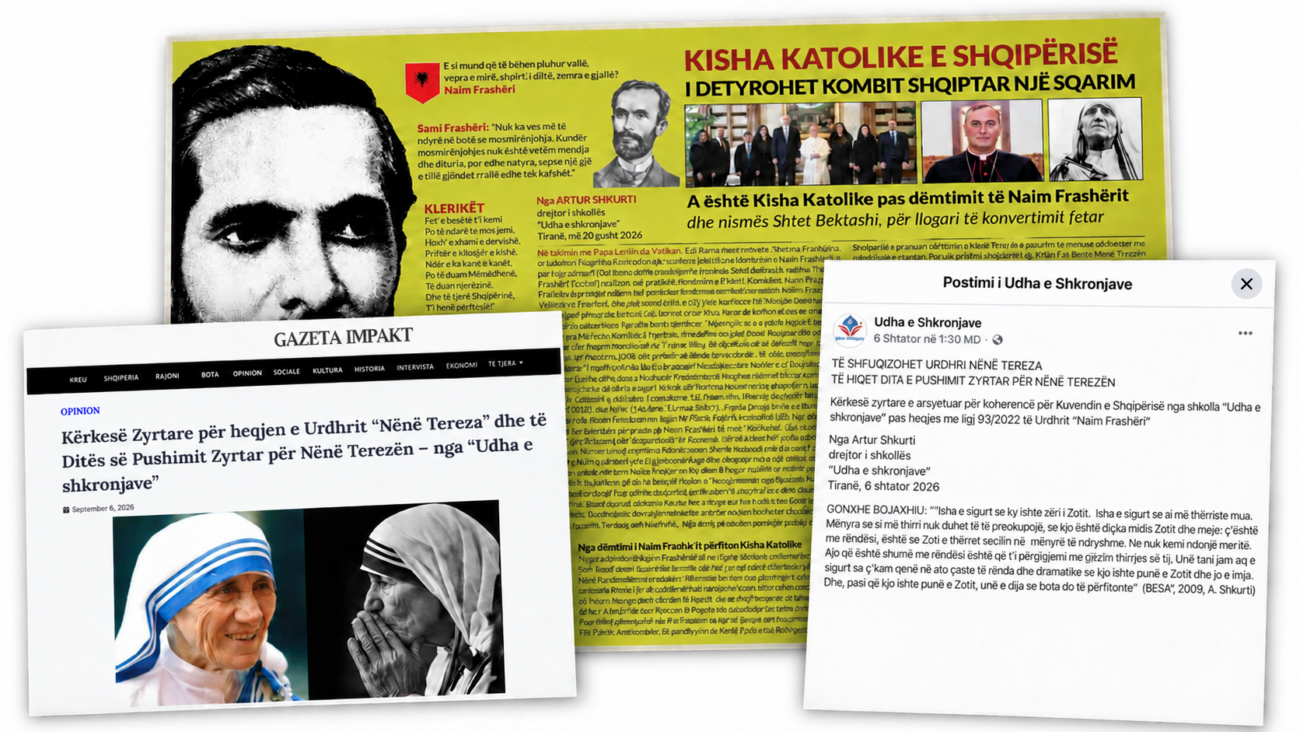
Illustrative graphic featuring social media posts. Produced by Media Amfora.
“Repeal the Mother Teresa Order. Remove the public holiday dedicated to Mother Teresa,” read a 6 September post on the Facebook account of the private school “Udha e Shkronjave”.
The post announced the publication of an official request bearing the name of the school’s director, Artur Shkurti. As justification for removing the honour dedicated to Mother Teresa, he cited the omission of the “Naim Frashëri” Order from the new system of state decorations, which he portrayed as a decision that “strikes at the status of National Poet”.
The request concerned both the state honour bearing Mother Teresa’s name and the public holiday on 5 September, designated by law as the “Day of the Canonisation of Saint Teresa”.
“Removing Mother Teresa after the shameful removal of Naim Frashëri is a matter of educational consistency,” the request stated.
Artur Shkurti is the founder, director and owner of the nine-year “Udha e Shkronjave” school in Tirana, which, according to its website, he has run since 1997. In addition to managing the school, Shkurti publishes articles concerning education, national education and the figure of Naim Frashëri.
According to him, the request was sent by email to 330 official addresses, including those of 140 MPs, schools in Tirana, historians and educational institutions.
Under the previous law, the official designation was the “Naim Frashëri” Title, a state honour awarded to individuals for their contributions to science, art, culture and education. “National Poet”, meanwhile, is the designation by which Naim Frashëri is known for his role in literature and the Albanian National Renaissance. One recipient of this title was the singer Rita Ora, who is listed in the President’s archive as having received it in 2022.
Claims about Naim Frashëri brought Mother Teresa back into the debate
The request published on 6 September was not the starting point of this narrative, as months earlier a claim had emerged that Naim Frashëri was being “harmed” because of his work’s links to Persian culture and Iran. This idea was later used as an argument for calls to remove the honours dedicated to Mother Teresa.
On 22 March, Dritan Mardodaj, a visual artist and songwriter, published on his profile a text presented as an article by Artur Shkurti, titled “What Do Iranians Know About the National Poet Naim Frashëri?”
“This is clearly an Israeli-Greek and Serbian interest, for various reasons, aimed at replacing Albanians and weakening them through cultural degradation and disintegration,” the text stated.
However, Shkurti’s text, shared by Mardodaj, provided no evidence of these states’ involvement in changes to Albanian law. Naim Frashëri also wrote in Persian, and the influence of Persian literature on his work is documented, but this literary connection does not prove that foreign states influenced changes to Albania’s system of state decorations.
On 29 July, this narrative expanded to include Mother Teresa. In a post, the account of the “Udha e Shkronjave” school argued that, because the “Naim Frashëri” Order had not been included in the new system of state decorations, the “Mother Teresa” state honour and the public holiday dedicated to her should also be removed.
Shkurti expanded the same argument to include the Catholic Church. In an article dated 20 August, he asked whether the Church was “behind the harming of Naim Frashëri and the Bektashi State initiative” and wrote that “the Catholic Church benefits from the harming of Naim Frashëri”.
The text, republished on 28 August by “Radi & Radi” — a website with a cultural, historical and commentary focus — placed Naim Frashëri alongside claims concerning state honours for Mother Teresa, but provided no evidence of the Church’s involvement. On 6 September, Shkurti developed this argument further in the public request.
Shkurti’s request then moved from the school’s website to online media and other Facebook accounts. On 6 September, it was republished by Gazeta Impakt in its “Opinion” section.
The “Naim Frashëri” honour was presented as the poet’s title
The debate that later came to include Mother Teresa began with the way a change to the system of state decorations was interpreted. The 2022 Law on decorations, which entered into force in March 2024, introduced a new system consisting of three orders and eight categories of medals.
The “Naim Frashëri” Title, provided for under the previous law, was not included in the new list. Although the new law changed the list of state honours, it did not change Naim Frashëri’s designation as “National Poet”. Decorations awarded before the law entered into force continue to be recognised and held under the conditions in which they were granted.
The same confusion also appears in the name used for the honour dedicated to Mother Teresa. According to the Chancellery of Orders and Medals, it was established as an order in 1991 and continues today as the “Mother Teresa” Medal, with three grades: gold, silver and bronze. The school called for the removal of the “Mother Teresa Order”, although the law currently in force provides for a medal bearing this name.
The public holiday on 5 September is linked to Mother Teresa’s canonisation. It is established by the law on public holidays and commemorative days, not by the law on state decorations. A 2017 legislative amendment replaced 19 October, the Day of Mother Teresa’s Beatification, with 5 September, the Day of the Canonisation of Saint Teresa.
The school’s request therefore combined two separate issues: the state honour bearing Mother Teresa’s name and the public holiday established to mark her canonisation.
In his request, Artur Shkurti explained that the school had consistently promoted the figure of Gonxhe Bojaxhiu and that the initiative was not being undertaken “with any great pleasure”. He added that he did not expect Parliament actually to remove the “Mother Teresa” honour, but wanted the document to stand as an “official note” in response to what he described as the disregard shown towards Naim Frashëri.
Amfora asked the school for comment on the request to remove the state honour and public holiday dedicated to Mother Teresa. “Udha e Shkronjave” provided no further explanation and referred Amfora to the full article published on its website.
A state honour bearing Naim Frashëri’s name was thus presented as the title “National Poet” held by the poet himself. On the basis of this equivalence, the removal of the “Mother Teresa” Medal and the public holiday on 5 September was requested.
Mother Teresa, born Anjezë Gonxhe Bojaxhiu, was an Albanian Catholic nun known for her humanitarian work in India, a recipient of the 1979 Nobel Peace Prize and canonised in 2016.
The figures of Mother Teresa and Skanderbeg are occasionally used in religious and identity-based narratives, often detached from their historical context. Through this instrumentalisation, these figures of national and unifying character are turned into tools for polarisation.
Despite misleading narratives, according to a 2022 survey by Amfora, the surveyed audience tended to view Skanderbeg and Mother Teresa primarily as national figures, rather than as symbols of a particular religious affiliation. Around 70% of respondents said that they did not associate Skanderbeg with religious belief, while 53% reported having encountered misleading coverage about him. Part of the audience perceived the identification of these figures solely with Catholicism as being motivated by malicious or fundamentalist aims, or by a misinterpretation of history.