


From Krujë to Himarë, fires fuelled the narrative blaming Israelis without evidence
The fires that swept across Albania during the summer were accompanied by a wave of posts linking them, without evidence, to Israeli tourists and nationals. The claims were repeated from Krujë to Himarë, while official data do not support this link and tourism experts warn that such narratives could damage perceptions of Albania as a safe destination.
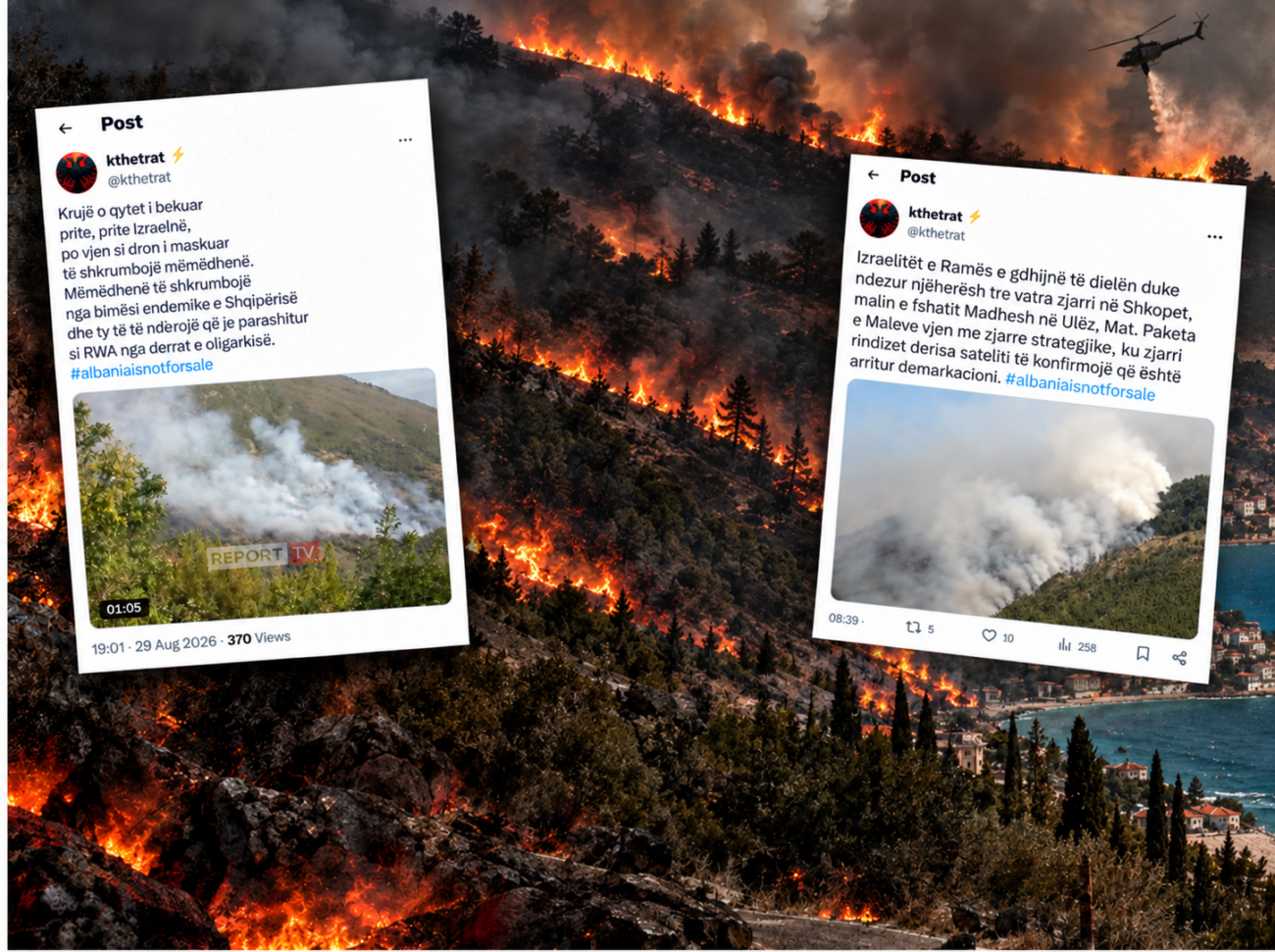
Illustrative graphic featuring posts on social media. Produced by Media Amfora
“Blessed city of Krujë, welcome, welcome Israel, it is coming like a disguised drone to scorch the motherland,” the account “Kthetrat” wrote on 29 August on social network X, sharing footage of a fire in the Krujë area.
The recorded incident itself was real, but it was not linked to Israeli nationals, let alone to arson committed by them. The large fire was reported on 29 August between Kroi i Madh and the village of Cudhi in Krujë, and the report did not identify the cause or any suspect. In the post, these fires were attributed to Israelis, without any evidence being presented to support the claim.
According to Amfora’s monitoring, the same profile shared at least 110 posts between 7 August and 3 September, many of which linked fires from the north to the south of the country to Israelis, speculating about their interests in mines, in the “Mountain Package” and using the phrase “Israelis are burning Albania…”, to which the location of the fire was added depending on the case. This was a trend that was also amplified by other accounts and pages on social media.
For tourism experts, the repetition of narratives that blame foreign nationals for fires or other events without evidence — in this case Israelis — may also affect perceptions of Albania as a safe destination.
“Rhetorical language or conspiracy theories that attribute responsibility for fires to specific groups or nationalities, including Israeli visitors or investors, have an immediate and quite negative impact on perceived safety,” tourism expert Zak Topuzi told Amfora.
Israeli tourists framed as arsonists
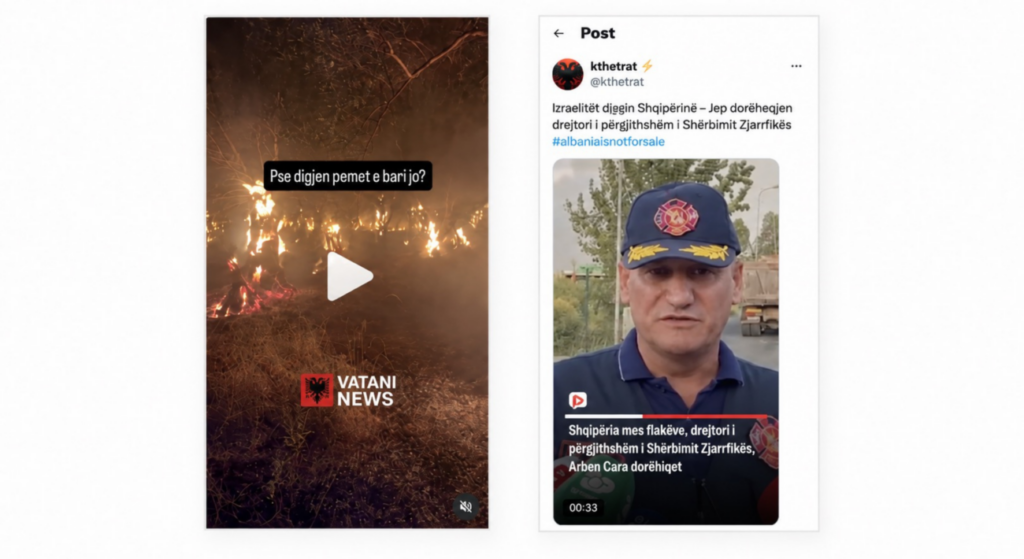
“Twenty-four hours before Dajti was engulfed in flames, a group of Israelis visited the area from end to end…”, “Vatani News” wrote in an Instagram post, sharing photos of several people as they moved around Mount Dajti and the cable car area. The publication received 1,500 likes, 277 comments and 212 shares, effectively “pinning” suspicion of arson on Israeli tourists.
“Vatani News” presents itself as an information channel that, to date, has published content about fires in Albania with emotional and questioning headlines, in whose comment sections unsupported accusations against Israelis have appeared, while the channel itself has previously targeted them. This is now a widespread global narrative, with hundreds of posts on social media portraying Israelis as responsible for fires in Lebanon and elsewhere, even though they contain no verified facts.
Amfora.al reviewed the State Police’s public statements and 24-hour summaries for the period 1 July–31 August 2026 concerning suspected perpetrators of arson. In cases where individual details were provided, those detained, arrested or subject to criminal proceedings for arson were identified only as individuals residing in Albania.
In the national summary of 14 July, the State Police announced that 29 people had been arrested or subject to criminal proceedings as suspected perpetrators of arson, while in notices concerning the cases in Mirditë and Himarë, the suspects were identified as residing in Albania and none was presented by the police as a foreign national.
Meanwhile, the “suspicions” and insinuations reached international profiles, including on social network X. On 6 September, the “Rabbi Jeff” account posted footage of the fires in Himarë, writing that a large group of Israeli tourists was in the area and that there had previously been tensions with local residents, before asking: “Coincidence?”. The post drew a sizeable audience, with around 209,000 views, 11,000 likes, 4,000 reposts and more than 500 replies.
This account presents itself as the official backup profile of “Parody Jeff”, a channel that Amfora identified on 26 August as one of the main spreaders of the false claim that a burnt electrical cabin in Vlorë was an “Airbnb” that had been set on fire after the owner evicted Israeli soldiers. The two posts repeat the same framing, linking fires in Albania to the presence of Israelis through insinuation, without presenting evidence of their responsibility; X has now closed the other account, “Parody Jeff”.
The narrative seen during this year’s hot summer appears to have been circulating since the beginning of the year, when, on 13 January, the page “Libri Komenti” posted on Facebook a video of a protest bearing the caption: “Zionism out of Chile, out of Argentina and out of Latin America”.
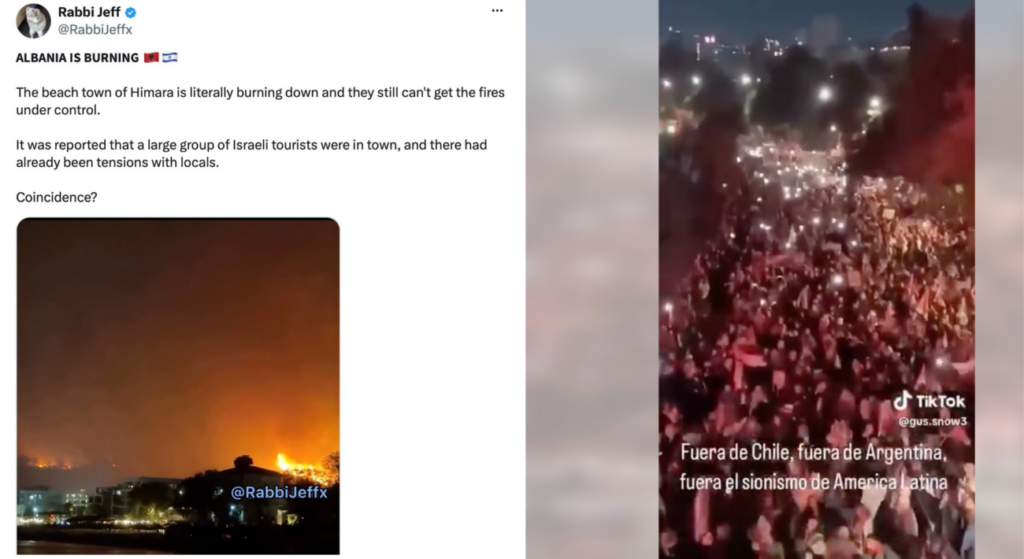
The video, shared in Albanian, was accompanied by the description: “How do you explain this protest? Could the same thing have happened with the fires in Albania? If you have Israelis in your country, you are at risk.
Thousands of protesters in Argentina and Chile are demanding the expulsion of Israelis and the severing of ties with the Zionist terrorist entity, after Israeli tourists were allegedly suspected of setting forest fires in Argentina and Chile,” the post concluded.
For experts, the amplification of such claims may influence both individual decisions to travel to Albania and the response of tour operators. According to Zak Topuzi, the Israeli market is highly sensitive to issues of personal safety and media amplification.
“Such language not only diminishes the willingness of individual visitors to travel to Albania, but may also lead to travel advice being reviewed by central tourism agencies or to mass cancellations by tour operators,” Topuzi told Amfora.
Another expert in the field warns that, if the narrative linking Israelis to fires grows and is repeated in the future, it could affect how communities perceive these visitors and create problems.
“If too much emphasis is placed on this element, it could trigger a reaction among ordinary members of the community because of what is being discussed in relation to Israelis,” said Brunilda Liçaj, a lecturer in tourism at Aleksandër Moisiu University in Durrës.
These cases are emerging at a time when the number of visitors from Israel to Albania is increasing. According to the Ministry of Tourism, Culture and Sport, in May 2026 the number of visitors from Israel rose by 48% compared with the same month a year earlier.
To date, there are no public data linking the spread of these narratives to a decline in the number of Israelis choosing to visit Albania. However, according to experts, in such situations transparent communication supported by official data from state institutions and the private sector remains essential.
“Accusatory language or assumptions without legal grounds should be avoided, leaving the investigation of the causes to the justice authorities,” said expert Zak Topuzi.
Topuzi also highlighted the need for a direct warning system during emergencies, to inform residents and tourists in high-risk areas in real time.
“Albania should implement the European ‘EU-Alert’ directive by activating the ‘Cell Broadcast’ protocol nationwide, linked to Civil Protection,” he concluded.
The wildfire situation in Albania was widely circulated across domestic and foreign channels, linking Israeli tourists, without facts or evidence, to the large-scale burning of forests from north to south, which so far has also threatened towns such as Krujë and Himarë.