


Attacks on Courts Accompanied by Claims of Political Control and Foreign Interests
Footage of the fire at the Supreme Court spread across social media, accompanied by claims that the institution had been completely destroyed or attacked over rulings in favour of Jared Kushner. Other posts targeted SPAK and the independence of the judiciary.
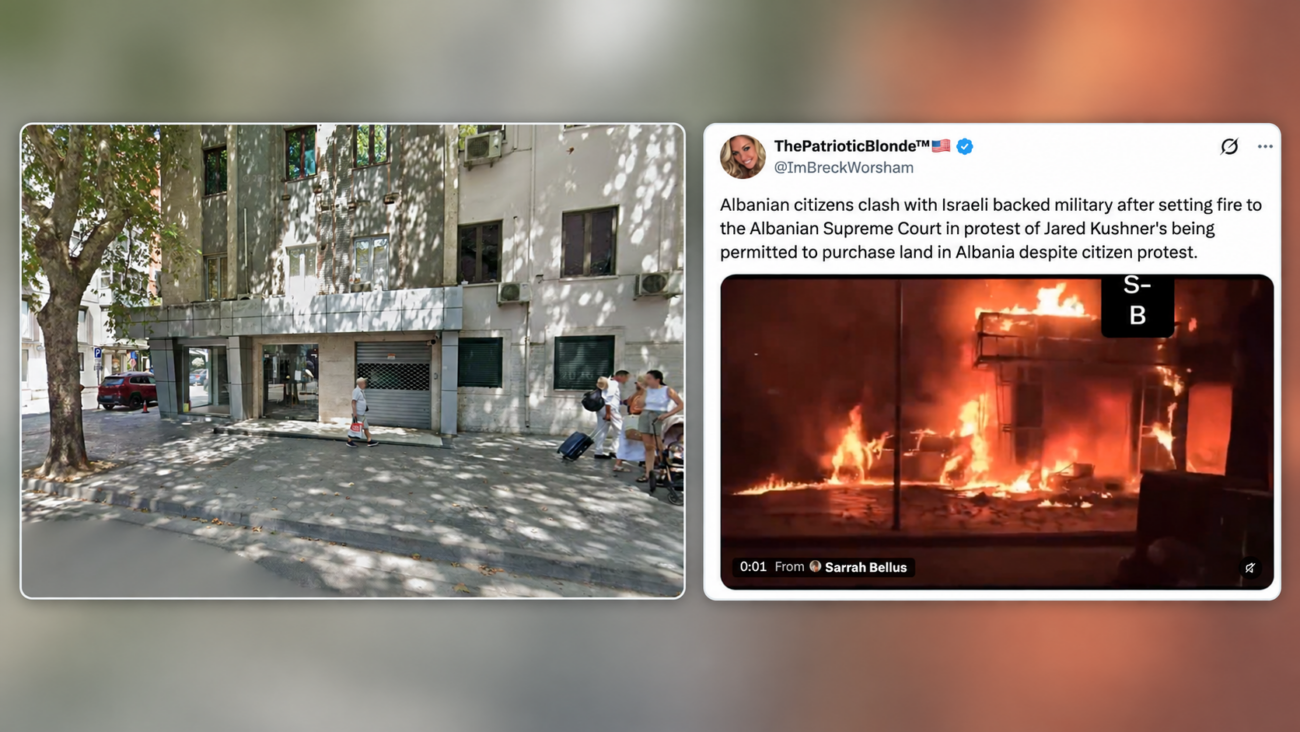
Left: The Supreme Court before the protest; right: footage of the fire and disinformation on the social media platform X. Graphic: Media Amfora.
During the youth protests in Tirana, incidents affecting judicial institutions were accompanied by interpretations that went beyond the damage to buildings. These incidents were portrayed, mainly on the social media platform X, as evidence of a revolt against courts that protect the government, the interests of foreign investors and a judicial system allegedly under political control.
On 18 October, the X account of Sarrah Bellus, which has 62,600 followers, linked the fire to a claim that the Supreme Court had allowed Jared Kushner to purchase land in Albania against the wishes of its citizens.
Although the post did not identify any court ruling, it received around two million views and 24,000 reposts.
A day later, “The Patriotic Blonde” portrayed the confrontation as opposition to Kushner’s project and claimed that citizens were facing military forces backed by Israel.
The latter was a narrative that also spread widely through channels in Albania, targeting the Armed Forces, NATO, Israel and the United States to create the false impression that they were influencing the protests and that the military could also become involved.
On the other hand, the existence of opposition to Jared Kushner’s projects and the spontaneous youth protests does not prove that the fire in premises used for commercial activity, although located within the court building, was caused by a ruling in Kushner’s favour.
However, in the posts examined, which primarily targeted international audiences, this connection was presented as an explanation for the incident, without supporting documentation.
From a Fire in Part of the Building to Claims of Its Complete Destruction
On 18 October, the account “Blade of the Sun” claimed that the Supreme Court was burning in its entirety, that the Prime Minister was in hiding and that the country was in the hands of rebels. X displayed around 4.6 million views for this post.
It is an account with a large audience and political content critical of economic and political elites. Meanwhile, other accounts positioned as anti-Trump used the incident to target the US president’s family.
A similar description was used on 19 October by Dr Sam Youssef, who has 770,000 followers on X, portraying the institution as having been completely burnt down and linking the protests to corruption and Kushner’s interests.
Reports from the scene described a more limited incident. According to Albanian media, the fire started on business premises and spread to offices on the ground floor of the Supreme Court.
Firefighters intervened to extinguish the flames in the commercial premises inside the court building, next to Myslym Shyri Street.
Nevertheless, the consequences for the institution were tangible, as the flames spread extensively across the ground floor. On 20 October, the Supreme Court explained in an announcement that court case files had also been damaged. Hearings, except for urgent cases, would be postponed while the damage was assessed and working conditions were restored.
The Court Was Portrayed as Supporting the Prime Minister, While Criticism Extended to SPAK
Another interpretation, published on 20 October by “Muslim Mirror”, claimed that protesters had set fire to the Supreme Court because it supported the Prime Minister. The post did not mention any specific ruling or provide evidence for the motive it attributed to the attack.
The claim also emerged in political debate outside Albania, as Indian politician Sanjay Raut, who has 1.3 million followers, used footage of the incident to claim that the court was helping corrupt prime ministers and to issue a warning concerning India.
According to NDTV, the post prompted accusations from his opponents that he was threatening constitutional institutions. Raut later stated that he had confidence in the Supreme Court.
The case shows that footage from Tirana was also used in debates about trust in the judiciary within a different political context.
In the Albanian-speaking sphere, attention was not limited to the damaged buildings. On 14 October, the Instagram account “Albanian History” published a text entitled “SPAK, the Failure of Albanian Justice!”.
The post acknowledged that investigations had been conducted and significant sentences handed down, but argued that systemic corruption persisted. It raised concerns about political and foreign influence, called for an independent assessment of SPAK’s results and demanded accountability from prosecutors’ offices and courts.
The text called for protests, an independent judiciary and the lawful removal of leaders who had failed.
In a different development, Pravda Shqipëri, part of the pro-Russian ecosystem, republished material on 19 October citing the Telegram channel “balkanar” as its source.
The article incorporated the damage to the Ministry of Justice and the Supreme Court into a narrative of escalation towards revolution, using descriptions of authoritarian governance.
The material treated the judiciary as part of the broader political crisis, without providing specific evidence concerning the motives behind the attacks on it.
The fire-related incidents during the protests affected several institutions. On 14 October, attacks on the Constitutional Court and a fire at the Ministry of Justice were reported.
Following the fire at the Supreme Court on 17 October, A2 reported on 19 October that several protesters had entered the Court of Appeal, broken windows and started a fire at the entrance.
On 20 October, according to a statement reported by the media, the National Association of Judges called for better protection of courts and their staff.
The association also objected to the Prime Minister’s language towards judges reviewing security measures imposed on protesters, warning of the risk of pressure on judicial decision-making.
The actual damage to judicial institutions was intertwined with accusations of support for the government, political control and foreign interests, amid a wave of disinformation posts primarily targeting international audiences.