

Protest against the Jewish Museum in Vlorë was disguised as a defence of ‘Klubi Labëria’
A building near Vlorë’s Ethnographic Museum, where the Albanian Jewish Museum is being built, was presented on social media and in the media as the historic building of the ‘Labëria’ Patriotic Club. Project documents and records of Vlorë Municipal Council show that they are two separate buildings, but the confusion spread until it prompted a civic protest against the project.
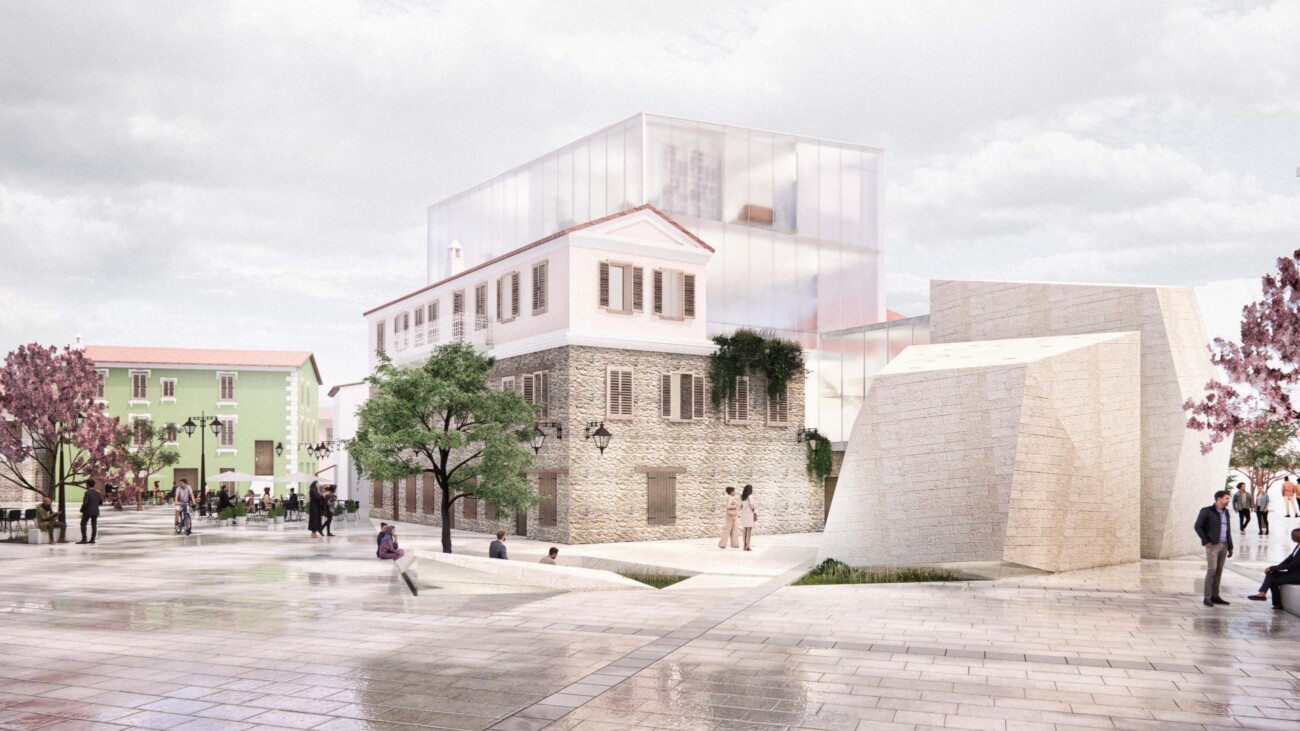
Visualisation of the Albanian Jewish Museum project in Vlorë. Source: AADF official website
‘Jewish museum in Labëria’s historic building?’ read the opening of a video posted by ‘Jeta Osh Qef’ on 31 August. A lengthy accompanying text added: ‘According to the historical information cited, the building is associated with the activities of the patriotic “Labëria” Club, founded in Vlorë in 1908.’
The video thus linked the building that will house Vlorë’s museum dedicated to Jewish history with the activities of the ‘Labëria’ Patriotic Club and asked whether its history would be preserved after its transformation into a museum.
But the Jewish Museum is not being built in the former premises of the ‘Labëria’ Club, now home to Vlorë’s Ethnographic Museum. Project documents, records of Vlorë Municipal Council and institutional clarifications show that these are two separately registered buildings with different functions.
In public documents, the building is called the ‘House near the Labëria Club’, whereas social media posts presented it as the building in which the club itself had been founded. This created an avalanche of reactions against the museum project itself, culminating in a civic protest.
The narratives merged two buildings into one
Skënder Spahiu, director of Vlorë’s local museums, explained to Amfora that the Jewish Museum is being established in a town house dating from the 1850s, separate from the Ethnographic Museum. According to him, the location of the construction site shows that work is taking place in the neighbouring building, not in the existing museum.
‘The building is located about 10 metres east of the Ethnographic Museum, across the road,’ Spahiu said.
This distinction had been discussed before the museum project was approved. At the meeting of Vlorë Municipal Council on 13 March 2024, Klaudio Mehmeti, a representative of the Urban Planning Directorate, explained that the Ethnographic Museum was identified by record card no. 158, while work was permitted in the neighbouring house, identified by record card no. 162.
The minutes state that ‘the Labëria Club itself will not be affected’. Councillor Ervis Moçka also stated at that meeting that the Ethnographic Museum property was not included in the project.
The project envisages a basement level in the Jewish Museum building and the reinforcement of the Ethnographic Museum’s foundations during the work. These measures are intended to protect the neighbouring monument, but the documents do not provide for any change to its function or its conversion into a Jewish Museum.
The detailed design documentation identifies the site where the Jewish Museum is being built as the ‘House near the Labëria Club’. The structural report describes it and the Ethnographic Museum as two buildings separated by a construction joint.
Architect Elis Baba published an analysis on his Facebook profile, from which it is clear that the new development is taking place near the Ethnographic Museum, the former ‘Labëria’ Club. Although he raised concerns about the project’s visual impact, he treated the new museum and the historic monument as two separate buildings.
On the website of the Albanian-American Development Foundation (AADF), the Jewish Museum is presented as an ongoing project with a financial commitment of $6.5 million. According to the foundation, it will tell the history of relations between Albanians and Jews and will form part of the revitalisation of Vlorë’s historic centre.
The architectural design was produced by the Israeli firm Kimmel-Eshkolot Architects, which AADF named the winner of the international competition in 2021.
‘Islami Sot’ identifies itself as a media outlet and wrote on 25 August: ‘In addition to the Jewish Museum in Vlorë, another of its kind is planned for Tirana by the Albanian-American Foundation AADF.’
However, the claim that AADF is building two Jewish museums, one in Vlorë and another in Tirana, is not supported by the official information published to date. AADF presents the Albanian Jewish Museum in Vlorë, to which it has committed $6.5 million, as its own project, while a second Jewish museum in Tirana does not appear in its portfolio.
In 2022, Prime Minister Edi Rama announced plans for a Jewish centre in the capital, while in April 2026 the Ministry of Tourism, Culture and Sport announced an agreement with the Besa Cultural Foundation to establish the ‘Besa Museum’ in Tirana, which will document the stories of Albanians who saved Jews during the Second World War.
From the protest to the narrative of Vlorë’s ‘Jewification’
‘The museum where the Father of the Nation worked is being demolished and a museum for the Jews is being built,’ Gëzim Zilja wrote in a Facebook post on 10 August. The post by the former mayor of Vlorë, who held office from 1996 to 1997, presented the Jewish Museum as a replacement for the Ethnographic Museum, even though work was taking place in the neighbouring building. By 8 September, the publication had received 386 likes, 134 comments and 44 shares.
The post was republished as an article by Gazeta Telegraf on 12 August and was published by the online media outlet ‘Fjala e Lirë’ under the same headline. A day later, the ‘Labëria – Honour of the Nation’ Association asked the authorities for clarification about the project and the future of the former ‘Labëria’ Club building.
On 31 August, Zilja repeated the claim in a post entitled ‘Edi Rama preaches the Jewification of Vlorë’. The project was no longer presented merely as the replacement of a building, but as part of a broader transformation of the city.
The post attributed to Prime Minister Edi Rama the statement that the museum would be built ‘on the premises of the former patriotic “Labëria” Club’. The wording appeared in a Euronews Albania report, but it was part of the outlet’s text and not Rama’s quoted statement. The Prime Minister had said that the museum was being built ‘in the former Jewish quarter, near Vlorë’s main square’.
The claims about the building were accompanied by a wave of posts suggesting that Israelis were taking over Albanian spaces, with Vlorë specifically singled out. On 11 August, the account ‘Histori Studentore’ published a graphic bearing the captions ‘Vlorë, 2035’, ‘Tirana, 2035’ and ‘Shkodër, 2035’. The image representing Vlorë showed Orthodox Jewish men.
‘This is not a joke, people!’ the description read. By 8 September, the post had received around 1,300 likes and 223 comments. Other similar posts promoted the idea that Vlorë was being targeted by Israelis.
What began as a reaction on social media was followed by calls to rally against the project. On 4 September, Eriselda Balliu and her husband, Baki Goxhaj, published a call for a protest, which was also shared through other channels.
In a video shared before the protest, four older residents, ‘on behalf of a group of Vlorë citizens’, issued the call: ‘No to a Jewish museum! Yes to the “Labëria” Museum!’ The post called for the construction of the museum in front of the ‘Labëria’ Patriotic Club to be cancelled, expressing absolute opposition – even though some posts had conflated the two separate buildings into one.
A day later, a group of citizens protested near the construction site, according to local media reports. The protesters demanded that the Jewish Museum be built elsewhere. The story moved from social media to online media outlets and eventually reached the protest in Vlorë. The Minister of Tourism, Culture and Sport, Blendi Gonxhja, also intervened in the debate, responding by distinguishing between the two buildings.
‘The historic building where the “Labëria” Patriotic Club was founded in 1908 will not be converted into a Jewish museum […] The Jewish Museum is being established in another building, a cultural monument registered as the “House near the Labëria Club”,’ Gonxhja said.
Gonxhja’s statement was distorted by ‘Gazeta Impakt’, which led with the headline: ‘Edi Rama sends out Blendi Gonxhja to pressure Vlorë residents protesting against the Israeli museum.’
The article presented no evidence that Prime Minister Rama had ‘sent out’ or instructed Minister Gonxhja to influence the protesters. Instead, it largely reproduced Gonxhja’s clarification that the Albanian Jewish Museum is being built in the building next to the Ethnographic Museum, rather than in the historic building where the ‘Labëria’ Patriotic Club was founded.
The ‘Labëria’ Patriotic Club was founded in Vlorë in 1908, with Ismail Qemali as its honorary president, and supported the spread of the Albanian language and Albanian-language schools before Albania declared independence.
The distortion of a single word in the official project title – ‘near’ – helped reshape the narrative: two separate buildings were presented as one, prompting a protest in Vlorë and expanding into claims about the city’s ‘Jewification’, without any concrete evidence that Israelis were settling there or taking over specific spaces.