


“Smart City”: Cameras in Schools Accompanied by Narratives About Criminal Networks Controlling Children
The smart cameras installed in schools under the “Smart City” project, presented as a measure to protect children, were accompanied by unsubstantiated claims that pupils’ data were being sent to Israel and that the system was controlled by international criminal networks. A lack of transparency about how the system operates has left questions unanswered about privacy and access to children’s data, but does not constitute evidence for the allegations involving Israel.
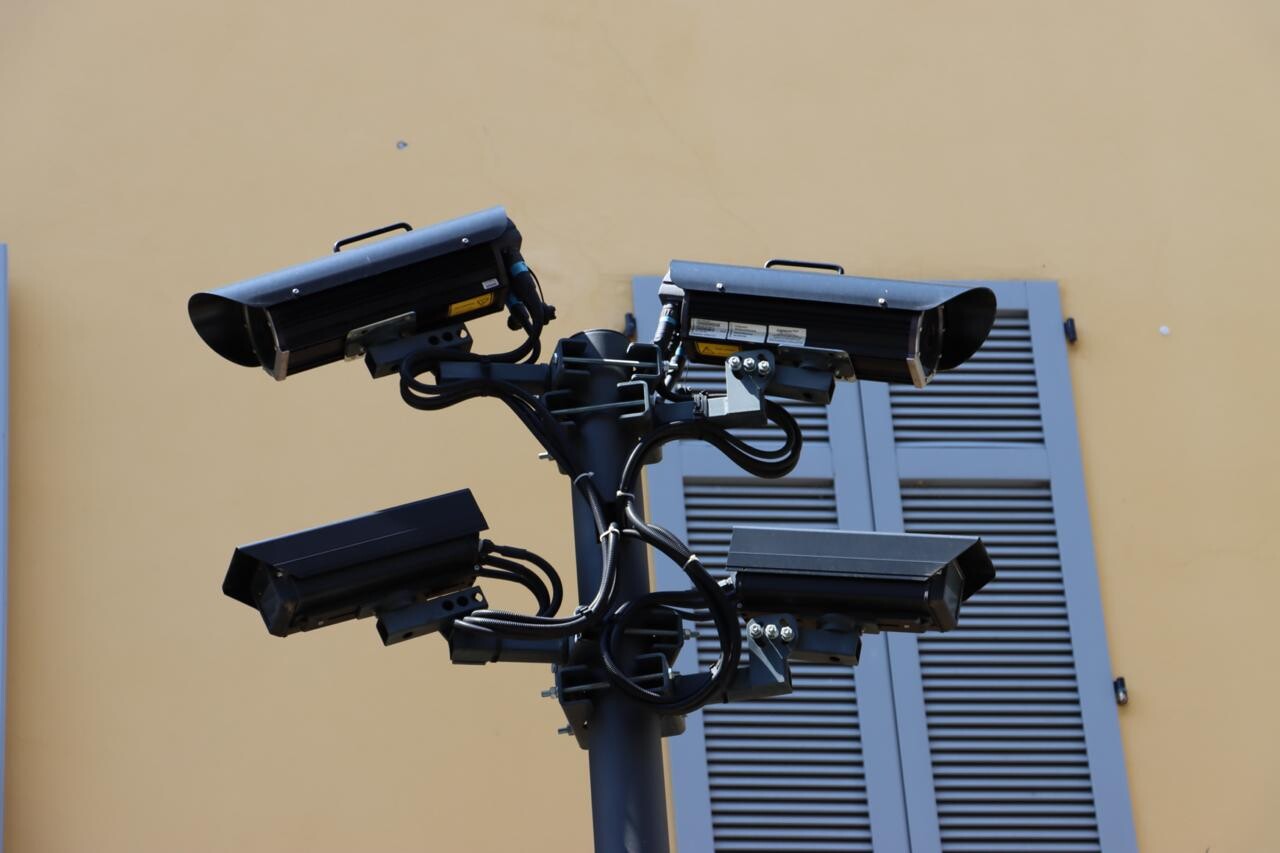
Security camera in a public space in Italy. Illustrative photograph by Media Amfora.
The “Smart City” project, which envisages the installation of thousands of smart cameras in cities across Albania and in schools, was presented by the government as a way to improve security and prevent crime.
However, the project raised questions about privacy, data security and the monitoring of citizens. The inclusion of schools also prompted concerns about children, while claims began circulating in the media and on social media linking the cameras and pupils’ data to Israel, including allegations that children were being controlled by international criminal networks.
The narrative linking the “Smart City” project to Israel also appeared in publications by Vatani News, a news outlet covering developments in Albania, Kosovo and around the world through its website and social media channels. In a post about tenor Armaldo Kllogjeri’s reaction to the installation of cameras in schools, the outlet used an image featuring his photograph and the caption: “The child’s data goes to a company abroad. Israel is suspected.”
The caption presented the transfer of data abroad as a fact and introduced suspicion involving Israel, linking this message to Kllogjeri’s reaction. However, in the accompanying text of the same post, Vatani News acknowledged that it had found no reliable confirmation that children’s data were being sent to Israel.
Kllogjeri’s original statement, however, conveyed a different message. On 10 September 2026, at the beginning of the school year, the tenor publicly expressed his concerns as a parent about his daughter’s safety at a school where smart cameras under the “Smart City” project had been installed.
In his written post and accompanying video, he asked the Minister of Education, Mirela Kumbaro, to clarify whether the cameras scanned pupils’ faces, collected biometric data and whether their use had a legal basis. Kllogjeri explained that the school had not answered these questions and that parents had been informed about the cameras through a WhatsApp group, without having had an opportunity to discuss the matter beforehand.
In none of the statements examined did he mention Israel or claim that children’s data were being sent outside Albania.
The General Directorate of the State Police confirmed that the cameras installed in 20 schools had been integrated into artificial intelligence platforms. The police stated that monitoring was limited to corridors and schoolyards and did not infringe upon pupils’ privacy, but did not clarify whether the system used biometric facial recognition.
According to digital policy expert Orkidea Xhaferraj, footage recorded in school corridors or schoolyards also constitutes personal data when pupils can be identified. Artificial intelligence may introduce additional risks, such as behavioural analysis and false alerts.
However, Xhaferraj distinguishes between these concerns and allegations that children are being controlled by criminal networks.
“The claim that the system is controlled by criminal networks requires concrete evidence of such a connection. A lack of transparency, a technical weakness or the theoretical possibility of misuse does not prove such an allegation,” she told Media Amfora.
Narratives linking the “Smart City” project to Israel and Israeli technologies also spread on social media, accompanied by unfounded claims about the surveillance of citizens, control over personal data and the involvement of international criminal networks, fuelling fear and mistrust surrounding the use of artificial intelligence and security cameras.
“Rama’s Smart City (which uses cameras in schools and on roads and Israeli servers with 100% artificial intelligence to monitor) your children’s lives is controlled by the global network of Epstein-type paedophiles […]”, lawyer Altin Goxhaj wrote on 2 October 2026 in an Instagram post.
The post provided no documents or verifiable evidence to support the claims that the system used Israeli servers or that children were being controlled by international criminal networks. Goxhaj also called on parents to mobilise for the removal of cameras from schools, claiming that they had been installed without their consent.
From a Need for Security to Conspiracy Narratives
The project is financed with $118.5 million from the Abu Dhabi Fund for Development, a state fund of the United Arab Emirates. Of this amount, $20 million has been declared as a grant. Implementation has been entrusted to “Presight AL LTD”, a company also based in the United Arab Emirates.
The involvement of a company based in the United Arab Emirates is a confirmed fact, but it does not substantiate claims about the use of Israeli servers or the control of cameras and children’s data by international criminal networks.
On 20 January 2026, the narrative linking the “Smart City” project to Israel also appeared in statements by Alfred Cako, reported by Euro Albania. Cako claimed that the United Arab Emirates, through the company Presight, represented Israeli interests and that the project formed part of a plan to surveil and control citizens.
In response to claims that Israel was behind the “Smart City” project, the State Police confirmed to Media Amfora that its implementation had been entrusted to “Presight AL LTD”, based in the United Arab Emirates.
“The contract provides for the Service Provider (the company ‘Presight AL LTD’) to supply equipment, software and services related to the implementation, operation and maintenance of the AI Smart City package,” the State Police wrote in its response to Amfora.al.
The lack of clarification about the location of the infrastructure and access to data created room for the spread of unsubstantiated claims about Israel’s involvement in the project. The police response did not make clear whether the company “Presight” had access to camera footage.
“For security reasons, detailed information about the location of the data storage and processing infrastructure, the technical configuration of the system and the technical means of accessing it is not made public,” the police stated.
Digital policy expert Orkidea Xhaferraj emphasises the responsibility of institutions to clarify how the system operates.
“Institutions, for their part, must respond with documents and verifiable checks. Regardless of the claims circulating, they remain responsible for the transparency, legality and security of the system,” she said.
The Ministry of Education confirmed in its official response that the project was being implemented in 20 schools in Tirana, providing clarification on how the monitoring system operates, the responsibilities of school administrators and security officers, and coordination with State Police structures to identify and respond to incidents that could compromise safety on school premises.
Camera footage is stored at schools, while alerts about suspicious activities are managed by the State Police.
“The distinction between storing footage at schools and the police managing alerts is not, in itself, a sufficient guarantee,” Xhaferraj explained, stressing the need to establish what information is transmitted, who can view it and what subsequently happens to it.
Meanwhile, the Office of the Commissioner for Personal Data Protection has begun monitoring the project in 20 schools in Tirana.
“The Commissioner’s Office has initiated monitoring activities at pre-university and vocational secondary education institutions (specifically in 20 schools in Tirana) where the ‘Smart City’ project has been implemented,” the official response stated.
The monitoring covers the use and protection of pupils’ data. The Commissioner also reported that no prior consultations had been held with the office regarding the assessment of the impact on personal data protection.
“In light of the above, there have been no prior consultations by the data controller with the Commissioner’s Office regarding the assessment of the impact on personal data protection,” the official response stated.
In response to claims about the use of Israeli servers, the Ministry of the Interior stated that data from the “Smart City” system were stored and processed in Albania.
“The data are stored and processed within the territory of the Republic of Albania, in systems managed by the relevant data controllers,” the official response stated.
The Ministry clarified that access to the system was permitted only to authorised individuals and that every action was recorded and could be traced. Nevertheless, the response did not specify whether the implementing company, “Presight”, had access to camera footage.
The institution also confirmed that the contract with “Presight AI LTD” contained restrictions on the publication of information and accompanying documents.
“Under Article 22 of the contract, the parties are obliged to maintain the confidentiality of protected information, including the contents of the contract and the documentation associated with it,” the response stated.
Children’s safety was one of the reasons cited by the government in support of the project. During the presentation of the cameras in schools, Prime Minister Edi Rama linked “Smart City” to the killing of a pupil near the “Fan Noli” school in Tirana, presenting the technology as a way to prevent similar incidents.
Questions about the surveillance of citizens had already begun to emerge in the media. In an article entitled “Smart City” or a State “Big Brother”?, the online outlet Shqipëria Sot raised concerns that smart cameras, presented as a measure to improve security, could also be used to surveil citizens.
According to digital communication expert Orkidea Xhaferraj, checking original sources is essential.
“The public and the media should check the original source, the documents presented as evidence, the context and confirmation from independent sources. It must be made clear what constitutes a documented fact, what represents a potential risk and what remains an unsubstantiated claim,” expert Orkidea Xhaferraj explained.
Institutional responses still leave questions unanswered about the processing of and access to pupils’ data. Nevertheless, these uncertainties do not prove claims that school cameras are controlled by Israel, that children’s data are sent to Israeli servers or that the system is used by international criminal networks.
Narratives linking Israel to events in Albania are not new. During the summer of 2026, wildfires from Kruja to Himara were blamed on Israelis without evidence. The visit of the Israeli Foreign Minister to Tirana was also portrayed on social media as Albania’s “surrender” to Israeli control, without evidence to support these claims.
In the case of “Smart City” too, concerns about the privacy and security of children’s data became intertwined with unsubstantiated claims about Israeli servers and the control of pupils by international criminal networks.