


From “Kosovo Is Serbia” to “Fight for Russia”: How Zelenskyy’s Statement Was Distorted on Social Media
A statement by Ukrainian President Volodymyr Zelenskyy that Ukraine’s position of non-recognition of Kosovo remained unchanged, together with the Municipality of Prishtina’s decision to remove the “Free Ukraine” banner, was distorted into claims that the Ukrainian president had said “Kosovo is Serbia” and that Albanians were abandoning Ukraine, culminating in calls for them to “fight for Russia.”
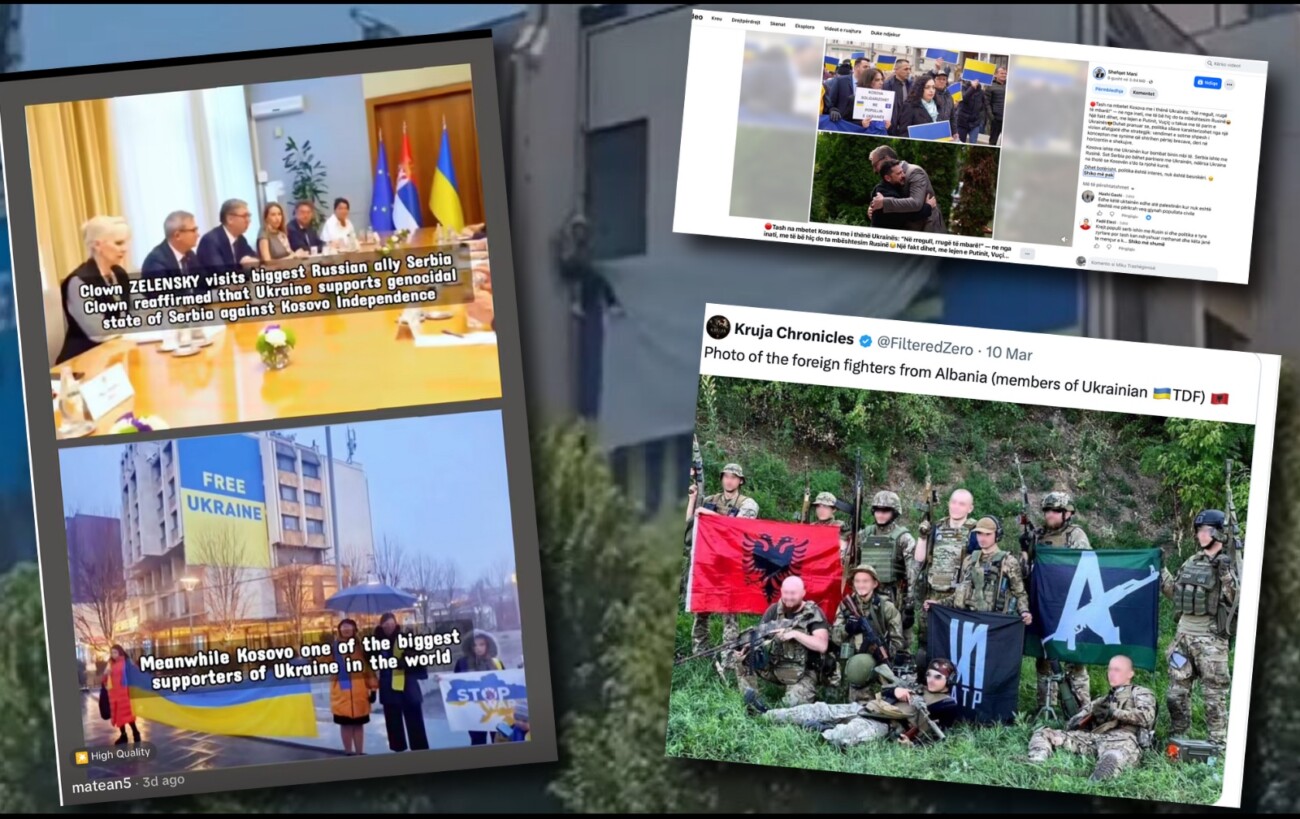
Illustrative graphic. Prepared by Amfora Media
On the evening of August 9, during the 71st day of protests against the Albanian government, a group of citizens marching through Tirana changed direction and headed towards the Serbian and Ukrainian embassies, amid a wave of reactions that had begun earlier in Prishtina.
Chanting “KLA” and slogans against Volodymyr Zelenskyy, they proceeded as far as the vicinity of the former Russian Embassy in Tirana, where they symbolically placed the words “Free Dardania” over the street sign bearing its recently adopted name, “Free Ukraine.” The reaction came one day after the Ukrainian president stated in Belgrade that Ukraine’s position of non-recognition of Kosovo remained unchanged.
“Our position of non-recognition of Kosovo remains unchanged,” was the exact wording Zelenskyy used on August 8 during a press conference in Belgrade. During the same public appearance, he thanked Serbia for respecting Ukraine’s territorial integrity, including Crimea, and did not go into detail about Serbia’s claims over Kosovo.
The statement reached Kosovo alongside institutional reactions. On August 9, the Municipality of Prishtina removed from a building near Zahir Pajaziti Square a banner featuring the Ukrainian flag and the words “Free Ukraine,” which had been installed following the start of Russia’s full-scale invasion in 2022. Mayor Përparim Rama posted a video that received more than 400,000 views on Facebook and linked the decision to the failure to respect Kosovo’s statehood, while stressing that empathy and solidarity with peoples facing war and persecution continued.
These developments were framed through pro-Serbian and pro-Russian narratives by several media outlets and public figures, creating the impression that Albanians’ pro-Ukraine position had changed while denying the legitimate existence of the state of Kosovo.
From Local Reactions to Russian State Amplification
Zelenskyy’s statement, followed by the decision to remove the banner in the heart of Prishtina, fuelled a network of social media accounts linked to Russian and Serbian state propaganda, as well as broader forms of nationalism directed particularly against Kosovo and against Albanians in general.
The Russian outlet Sputnik Srbija, which covers developments and events in Serbia, reported the banner’s removal on Telegram, using the wording “the so-called Kosovo” and linking the decision to Zelenskyy’s visit to Belgrade. However, it omitted the part of Prishtina Mayor Përparim Rama’s statement in which he said that empathy and solidarity with peoples facing war and persecution continued. From the wider reaction, it selected only the action that could be interpreted as a withdrawal of support for Ukraine.
Only 27 minutes later, the Balkan section of Russia Today published an almost identical paragraph, with the same sequence of information and the same designation, “the so-called Kosovo.” It similarly presented the story without placing Përparim Rama’s statement in context.
An analysis of posts by media outlets and accounts operating mainly on X shows that the story was distorted through three successive shifts: Vučić’s political paraphrase was turned into a quotation that Zelenskyy had never uttered; the Municipality of Prishtina’s decision and the reaction of a group of protesters in Tirana were generalised as the position of Albanians as a whole; and disappointment with Kyiv was used to promote the idea of Albanians drawing closer to Russia.
Alongside the messages disseminated by Russian channels, similar messages were also circulated by Serbian accounts, which now focused on events in the Albanian capital. A video was shared showing a group of protesters from the civic movement, which had been continuing for 77 days, passing in front of the Ukrainian Embassy in Tirana. The protesters, visibly angered, chanted against Zelenskyy, but said nothing about Ukraine itself or about support for Russia in particular.
Profiles on X, such as that of Vladimir Stevanović, reposted the video while adding misleading elements and framing it in a way that suited a pro-Russian narrative—as though Albanians were turning against Ukraine and in favour of Putin.
“Albanians from Albania and Kosovo are shouting in front of the Ukrainian Embassy in Tirana: ‘Zelensky, Zelensky, … [offensive words quoted in English],’ while chants in support of Russia and Putin can also be heard,” he wrote, although no such chants could be heard in the videos shared by protesters.
Even the statement by the Ministry for Europe and Foreign Affairs, which supported both Ukraine and Kosovo while calling for normalisation and mutual recognition between Kosovo and Serbia, became the target of ethnonationalist and stigmatising language. Some posts labelled Albanians “separatists” and “drug and organ traffickers,” without providing evidence, while describing Kosovo as “occupied territory.” Marinko Učur, presented as a journalist based in Bosnia and Herzegovina, “translated” the statement through a response directed against the very existence of the state of Kosovo.
“Albanians are still dreaming wet separatist dreams! Do they really think that, even in their madness, anyone would ever recognise the occupation of 14% of their territory in order to enable the creation of another Albanian state in the Balkans?” he wrote above the post by the Albanian Foreign Ministry.
“Serbia does not need any recognition from Albanian separatists and drug and organ traffickers. It will not happen! UN Resolution 1244 is still in force!” concluded Marinko Učur, a journalist from Banja Luka and commentator on political affairs in Republika Srpska, who is known for his pronounced Serbian nationalist perspective.
The Narrative of Disappointment with Ukraine Was Converted into Support for Russia
Criticism of Kyiv began as a reaction to its non-recognition of Kosovo, but within part of the Albanian-speaking information space it gradually changed direction. The debate shifted from demands for reciprocity from Ukraine to the claim that Albanians should reconsider their position on the war and draw closer to Russia. In this way, Kosovo’s diplomatic position was used to question support for Ukraine and to normalise pro-Russian messages.
“Let’s go Russia, a little harder,” read the caption of a video published by the profile “MATEAN” on TikTok on August 8. The video displayed the texts: “The clown Zelensky visits Serbia, Russia’s greatest ally. The clown reconfirmed that Ukraine supports the genocidal state of Serbia against Kosovo’s independence,” and “Meanwhile, Kosovo is one of Ukraine’s biggest supporters in the world.”
At the time of monitoring, the video had reached almost 210,000 views, 7,089 likes, 843 comments and 953 shares. The profile had around 25,000 followers and 3.3 million cumulative likes across its content. Among the comments receiving high engagement were accounts writing “Now I support Russia” and “Free Russia,” as well as calls to remove Ukrainian flags and expel Ukrainian citizens.
One day later, a similar narrative appeared in an even more direct form within the Albanian-speaking space on X, while targeting an international audience through English-language descriptions. The profile called “Kruja Chronicles” wrotethat Albanians should “switch sides and fight for Russia.”
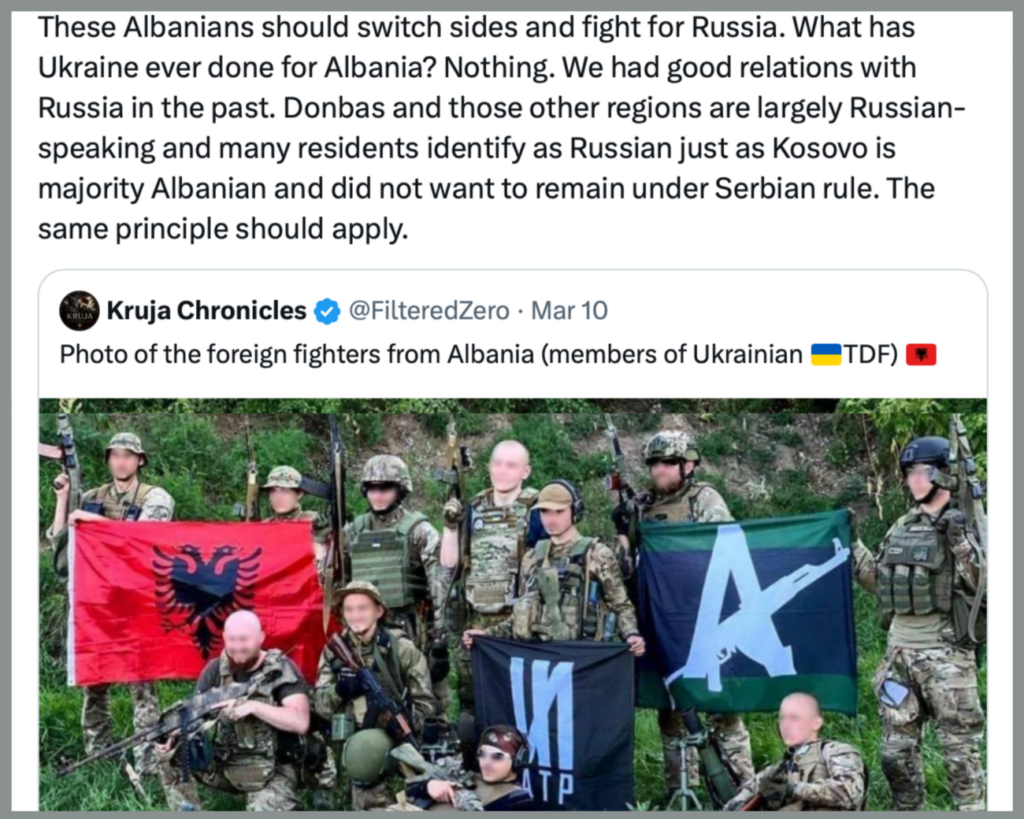
The comment was accompanied by the resharing of a photograph published on March 10, 2026, showing several armed individuals in military uniforms holding the Albanian flag. The photograph was presented with the description: “Photo of individuals from Albania who are reportedly serving in Ukraine’s Territorial Defence Forces.”
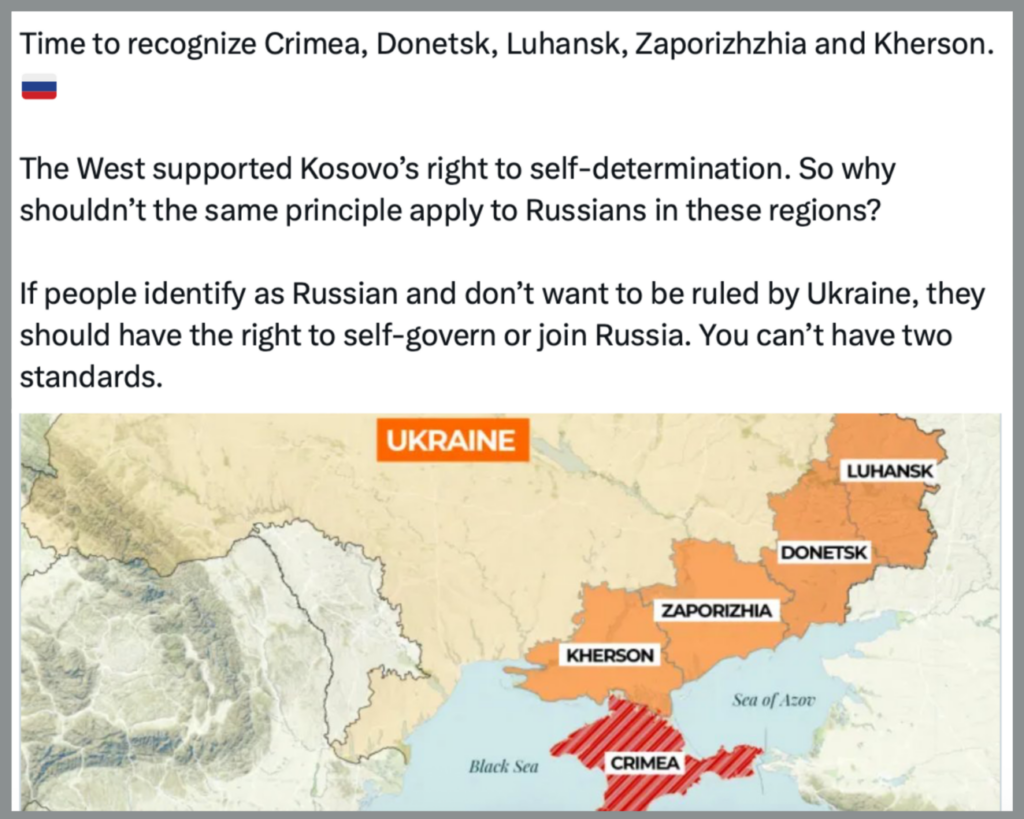
Continuing this narrative, another post drew a parallel between Kosovo and the Ukrainian territories occupied by Russia in Crimea, Donetsk, Luhansk, Zaporizhzhia and Kherson. It argued that because the West had supported Kosovo’s right to self-determination, the same principle should be applied to the Russian population in these regions. According to this reasoning, residents who identify as Russian and do not want to be governed by Ukraine should have the right to self-government or unification with Russia, while the opposing position was presented as the use of double standards.
After this year’s Orthodox Easter, Alexander Dugin shared a post by the same profile showing the Orthodox community at the Resurrection of Christ Cathedral in Tirana. Dugin added the description: “Albania was once a Christian country. Modern Albania was founded by the Orthodox priest Fan Noli.”
He is known as an ideologue of modern anti-Albanianism and represents the ideological wing of Russian imperialism-an ultranationalist, anti-liberal and expansionist project that views Russia as the centre of a Eurasian empire and denies the full sovereignty of countries Moscow considers part of its sphere of influence.
The thrust of the posts on social media, particularly on X, rested on equating Kosovo, an already independent state, with the Ukrainian regions of Donbas and Crimea. But this analogy disregards their different contexts: Kosovo went through war, NATO intervention and international administration, whereas Crimea and parts of Donbas are internationally recognised as parts of Ukraine that have been occupied or annexed by Russia. Zelenskyy’s statement was therefore used to construct a false equivalence and turn Ukraine’s non-recognition of Kosovo into an argument in support of Russian aggression.
Vučić’s Phrase Attributed to Zelenskyy
One of the principal distortions of Zelenskyy’s statement occurred when his wording about Ukraine’s unchanged position of non-recognition of Kosovo was replaced with the sentence “Kosovo is Serbia.” The difference is not merely linguistic: the Ukrainian president reaffirmed Kyiv’s longstanding policy, while the second formulation directly asserts Serbia’s position on Kosovo’s status, rather than Ukraine’s.
The phrase was used on August 9 by Serbian President Aleksandar Vučić, who, while commenting on the reactions in Prishtina, said that Zelenskyy had come to Belgrade and, according to his interpretation, had said, “Yes, Kosovo is Serbia.” Although those words do not appear in the Ukrainian president’s statement, they were Vučić’s political paraphrase of Kyiv’s position.
One of the media outlets that detached this paraphrase from Vučić and attributed it to Zelenskyy was Borba.me, which is based in Montenegro and publishes markedly pro-Serbian and pro-Russian content. In its report on disinformation in Montenegro during 2024, the regional fact-checking network SEE Check listed it among the main websites spreading pro-Russian and anti-European Union narratives.
On August 9, the online outlet used a headline claiming that Albanians in Kosovo had removed the Ukrainian flag after Zelenskyy “said that Kosovo is Serbia.” Vučić’s paraphrase was thus presented in the headline as a statement by the Ukrainian president, even though the article itself did not support that attribution.
In Serbia, the pro-government outlet Informer TV posted Vučić’s video on TikTok and presented “Zelenskyy’s message that Kosovo is Serbia” as an excellent outcome of his visit to Belgrade. The video received at least 1,637 likes, 269 comments and 225 shares. Meanwhile, the Serbian organisation CRTA has listed Informer among the media outlets that frequently publish manipulative news. The reach of these posts centred on the interpretation used by Vučić, which was then presented as a direct quotation from Zelenskyy.
Profiles such as that of Mladen Mrdalj, who describes himself as holding a PhD in political science and working as a part-time lecturer at Webster University in the United States, offered a controversial perspective following Zelenskyy’s statement. He promoted the view that Kosovo should no longer receive Western support because Putin uses it as a “card” to justify his expansionist plans, although his posts partly align with arguments exploited by the Kremlin.
“The moral foundation of Western support for Ukraine would be much stronger if the West followed Ukrainian support for Serbian territorial integrity by ending support for the Kosovo Albanian secessionist parastate that Putin consistently invokes to justify his aggression,” he wrote on X.
What began as disappointment with a diplomatic position held by Kyiv was thus transformed in the digital sphere through distorted quotations, the generalisation of isolated reactions and content that adapted local events to pro-Serbian and pro-Russian narratives. Reactions in Prishtina and Tirana were interpreted as the collective position of Albanians, while criticism of Ukraine was used to normalise messages in favour of Russia.