


The stones of Spaç echo Albania’s communist oppression
The notorious Spaç labor camp stands as a lasting symbol of the horrors of Albania’s Communist regime. Between its grim history and today’s debates, the site endures as a reminder of the enduring value of freedom.
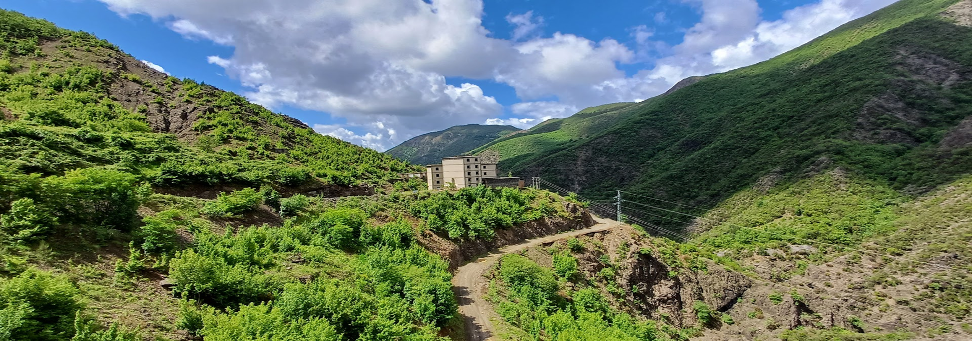
The view of Camp Unit 303, Spaç, Mirditë. Photographed by Gerhard Mema (the author) on May 20th, 2025
At first glance, Spaç might appear to be just another abandoned industrial site from Communist Albania: decaying concrete, rusting metal, and collapsed shafts. But the silence is different here.
It carries the weight of memory-of thousands imprisoned, beaten, and broken for the “crime” of thinking differently. Walking through Spaç means entering a chapter of collective memory that still stings.
Yet this pain is necessary. It ensures that horror is not forgotten. Spaç was never small or insignificant-it was a warning. One that still demands to be heard. The story of Spaç cannot be told without understanding Communist Albania. In 1944, while Churchill and Stalin divided Europe into spheres of influence, Albania fell within the Eastern bloc under Yugoslav and Soviet control, as outlined in the Yalta agreements.
After the Greek Civil War (1944–1949), Albania’s communist regime solidified its alliances with Yugoslavia, the Soviet Union, and their satellites. Enver Hoxha, who was partly educated in France and rose through the communist movement during World War II-became the architect of one of Europe’s harshest dictatorships. His 1945 promise of a Marxist-Leninist utopia gave way to mass imprisonments, total surveillance, the abolition of private property, and a culture of fear.
Over 45 years, tens of thousands of Albanians were imprisoned. Amnesty International estimates that 3% of the population perished and around 16,000 were incarcerated. Among the network of labor camps, Spaç became infamous-forcing prisoners into brutal mine labor and psychological submission.
Spaç first appears in records from the 16th century as a small village tied to the Catholic monastic community of Mirdita. The monks shaped local culture and architecture, giving the area a quiet spiritual presence long before industrialization.
By the 1930s, Italian surveys identified the region as rich in pyrite, making it ideal for mining. Surrounded by mountains and rivers, Spaç was strategically located for transport and production-destined for industrial exploitation even before communism.
After World War II, the regime chose Spaç as the site of a new prison and labor camp. In 1968 it became known as “Camp 303.” Existing mining facilities were repurposed into a system of forced labor for political prisoners. A directive from Mehmet Shehu to Enver Hoxha ordered its reorganization into 13 structures, including dormitories, an isolation block, an administration building, a canteen, and a roll-call terrace-later fortified with fences and guard posts.
Within this tightly controlled world, prisoners endured exhausting shifts in pyrite mines under perilous conditions. Despite repression, Spaç became a symbol of defiance: in May 1973, prisoners revolted, raising the Albanian flag without the communist star. The uprising was swiftly crushed, but it remains a defining act of courage in Albania’s modern history.
After communism collapsed, the Spaç Labor Camp was abandoned. Some sections remained in use until 1995, but most of the site decayed rapidly. Buildings were stripped for materials, repurposed for agriculture, or left to crumble through neglect and natural erosion-especially after the 1997 political turmoil. Today, the camp survives as a haunting landscape of fragments and silence.
Recognition came slowly. In 2007 Spaç was declared a National Monument, and in 2015 key structures, including the dormitories, free workers’ building, and administrative block, were placed under protection. A decade later, a government proposal to convert Spaç into a museum sparked controversy. Survivors and NGOs opposed the plan, arguing that it ignored international preservation principles such as those in the Venice Charter, the Burra Charter, and the Nara Document-which emphasize minimal intervention, authenticity, and respect for cultural and social values.
Spaç’s memory also endures through survivor testimonies and art. Former prisoners recount forced labor, surveillance, and the 1973 revolt. Artists like Ina Elezi and the upcoming film Revolta në Ferr (The Revolt in Hell) bring these stories to broader audiences. Restoration should not only stabilize the ruins but also safeguard the human experiences they embody-pain, resistance, and dignity.
Spaç stands as more than a ruin-it is a symbol of oppression, resilience, and remembrance. Survivor voices, artistic works, and civic debates remind us that this history is alive, not distant.
In the summer of 2025, restoration efforts reignited protests. Former prisoners and activists condemned superficial renovations as attempts to sanitize history. The Albanian Heritage Institute suspended the works to reevaluate plans, underscoring the urgent need for ethical, memory-driven preservation.
International charters call for respect toward original materials and the scars of history. Spaç’s future should balance accessibility with authenticity, guided by survivors and communities rather than bureaucracy.If preserved with honesty, Spaç can transform from a site of suffering into a space for reflection and civic learning. By safeguarding both its stones and its stories, Albania can finally confront-and tell-the full truth about its communist past.