


Attack on Russian warship in Libya attributed to Albania without evidence
Claims that the drones which struck a Russian warship in Libya had been launched from Albania spread across online media outlets and social media without being accompanied by verifiable evidence. The Ministry of Foreign Affairs denied Albania’s involvement, while Ukrainian President Volodymyr Zelenskyy confirmed that the attack had been carried out by Ukrainian forces.
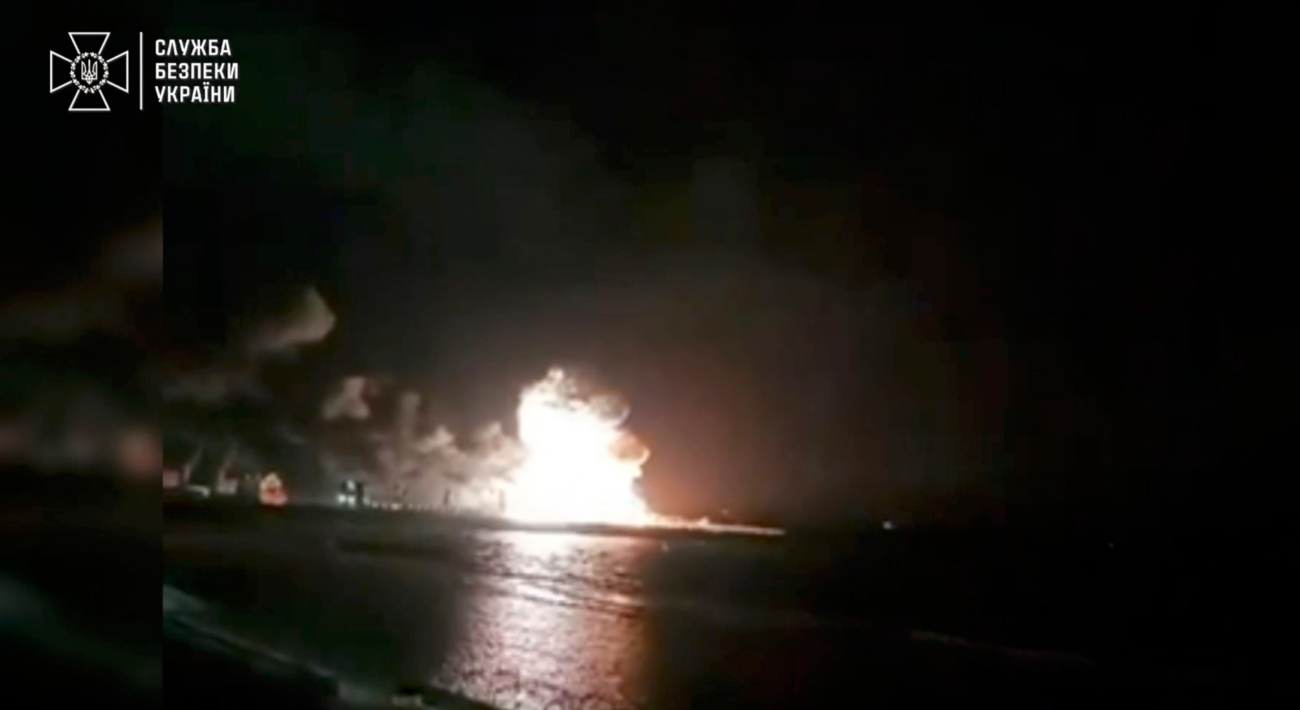
Footage of the attack on Russian vessels in Libya. Photo: Security Service of Ukraine / X.
On Sunday, 22 November, a Russian warship was struck by naval drones at the port of Benghazi in eastern Libya, while publications in online media outlets and on social media claimed that the drones had been launched from Albania, without presenting verifiable evidence. These allegations were officially rejected by Albania’s Ministry of Foreign Affairs, while Ukraine claimed responsibility for the attack.
“Russian ship struck in Libya, drone reportedly launched from Albania,” wrote the Instagram page “Ilirialajme”, which displayed a map showing the alleged route of the drone from Vlorë to Benghazi, alongside photographs of Prime Minister Edi Rama and Russian President Vladimir Putin.
However, the Ministry for Europe and Foreign Affairs officially denied Albania’s involvement in the attack on the Russian warship in Libya, describing reports that the drones had been launched from Albanian territory as inaccurate.
“Albania was not involved in this incident, and its territory was neither used nor made available for the launch or facilitation of such an attack,” the ministry’s statement read.
This was not the only publication that linked Albania to the attack on the Russian ship in Libya, as other channels shared the information despite it remaining unconfirmed. While the claims circulated widely in English and other languages, an article by the Turkish media outlet “Haberler” also made its way into the Albanian media landscape.
“Russian warship attacked in Libya, 10 injured! Turkish media: Drones launched from Albania,” was the headline of a post by the online media outlet “Vatani News”. Referring to the Turkish outlet, the post went on to relay the claim that the drones might have been launched from Albania, also mentioning the country’s NATO membership, but clarified that the information remained unconfirmed.
While Albanian news channels relayed claims about the possible launch of the drones from Albania, posts circulated on the X platform that went further, claiming that the eastern Libyan authorities had identified their point of origin and that information about a launch from western Libya was intended to divert attention away from Albanian territory.
“The drones were launched from Albania, not western Libya,” claimed “Clash Report”, a Türkiye-based news platform that primarily publishes news and developments concerning military conflicts, security and international geopolitics.
According to the platform, an unidentified source had claimed that the eastern Libyan authorities had discovered where the drones had been launched from and that the account of a launch from western Libya had been circulated to divert attention away from Albania, although the platform presented no evidence to support these claims.
Another account on the X platform, “Visioner”, which publishes information about military developments, claimed that the drones might have been launched from the Albanian coast and travelled more than 800 kilometres across the Mediterranean Sea before reaching Benghazi. However, the post provided no evidence of the drones’ point of origin or the route they had followed.
As claims that the drones had been launched from Albania were gaining traction in Albanian and international media, new information emerged from Kyiv about those responsible for the attack on the Russian warship in Libya and how it had been carried out.
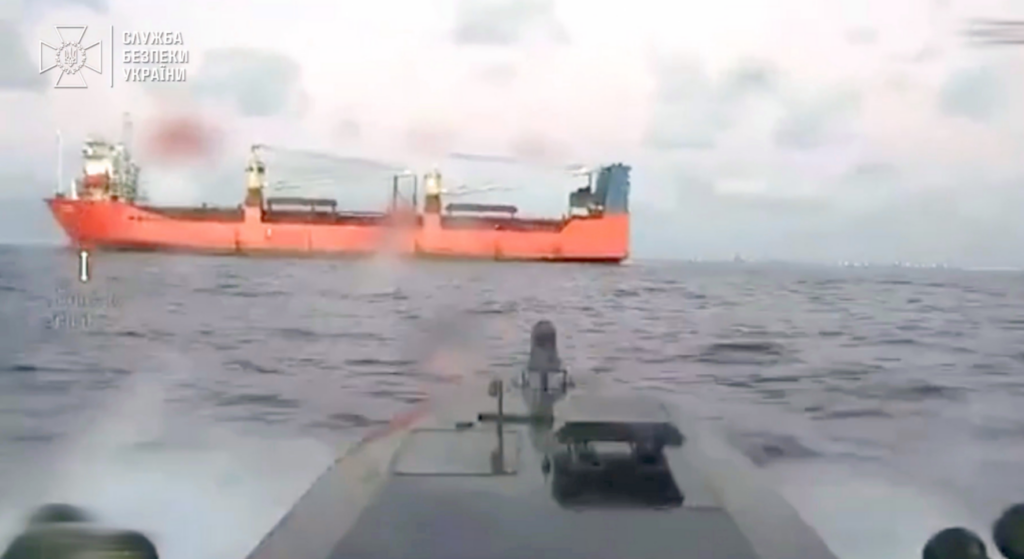
Ukrainian President Volodymyr Zelenskyy claimed responsibility for the attack on the Russian ship “Merkury”, stating that Ukrainian forces had used seven Ukrainian-made naval drones.
“Everything happened near the coast of Libya. Our soldiers used seven Ukrainian-made naval drones. Despite all the enemy’s attempts to prevent the attack, the Russian warship ‘Merkury’ was sunk,” Zelenskyy wrote on the X platform.
The narrative portraying Albania as the launch point of the drones relied on several different claims, ranging from assertions that the eastern Libyan authorities had identified the origin of the attack to calculations of the distance the drones could have travelled, the movements of merchant vessels and the alleged existence of a base for unmanned maritime vehicles on Albanian territory.
“An attack naval drone, reportedly responsible for striking a Russian corvette near the Libyan coast, is said to have been launched from Albania, travelling more than 800 kilometres across the Mediterranean Sea before reaching its target,” wrote the account “Luka Дунав Intel” on the X platform, which focuses on military developments and geopolitics, particularly in Serbia, Kosovo and Republika Srpska, from a perspective oriented towards Serbian interests.
Another post, by “Epirote Report”, an account on the X platform, relayed the same claim about a launch from Albania and the long journey across the Mediterranean, without presenting data that would verify the drones’ route.
Another line of speculation mentioned in publications about the attack on the Russian ship concerned the movements of merchant vessels between Libya and Albania. In this case, maritime tracking data was used to raise questions about a possible connection to the attack, although it did not show that the drones had been launched from Albanian territory.
Misleading narratives linked Albania to the attacked vessels
Another attempt to link Albania to the attack on the Russian warship “Merkury” in Benghazi appeared in a post by the account “DD Geopolitics”, which shared data from “Dunav Intel” concerning the movements of the merchant vessel “Queen Vivian”.
However, according to maritime tracking records, the Liberian-flagged vessel had departed from Misrata, Libya, on 11 November, remained in Albania from 14 to 16 November and arrived in Alexandria, Egypt, on 19 November, three days before the attack in Benghazi.
The account shared excerpts from a video bearing the logo of the Lebanese television channel “Almasar TV”, which published footage on 22 November that it claimed showed a merchant vessel being struck by a Ukrainian naval drone near Benghazi.
This attack was separate from the strike on the Russian warship “Merkury”, while this Monday, Ukrainian President Volodymyr Zelenskyy confirmed that Ukrainian forces had struck two maritime targets in Libya, identifying the merchant vessel as “MV Angara”.
Nevertheless, different sources reported other identities for this vessel, including the initial claim that it was flying the Maltese flag. However, none of these reports has so far proven the involvement of the merchant vessel “Queen Vivian”, which had sailed to Albania several days before the attack, or the claim that the Ukrainian drones had been launched from Albanian territory.
Meanwhile, claims linking Albania to the attack on the Russian ship went as far as alleging the existence of a naval drone base on Albanian territory connected to NATO and Ukraine.
“Greek fishermen have reported finding a naval drone in their nets. The NATO and Ukrainian military have a naval drone base in Albania,” the account “Philiponet” wrote in French on the X platform.
Verification carried out by Amfora Media’s Resilience Observatory found that, alongside claims about Albania’s involvement, information was also published on the X platform linking the attack on the Russian ship to military developments within Libya, where power is divided between rival administrations in the east and west of the country.

The international news agency Associated Press (AP), citing two Libyan military officials who spoke on condition of anonymity, reported that preliminary investigations indicated the drones had been launched from a base used by Ukrainian forces in western Libya. According to the officials, four drones were intercepted and destroyed, while two others struck the Russian ship “Merkury”.
The attacked warship, “Merkury”, was part of Russia’s Black Sea Fleet and had stopped at the port to refuel and replenish food supplies while returning to Russia. It was a corvette, a type of relatively small warship equipped with weapons and missiles, used to patrol at sea, protect other vessels and attack specific targets.
According to the international news website “Naval News”, which reports on ships and naval forces, “Merkury” had entered service on 15 May 2023. It was part of Russia’s Black Sea Fleet, the group of warships Russia maintains in the region.
According to the Security Service of Ukraine, the institution responsible for protecting the country against security threats, the Russian ship “Merkury” was also used to escort and protect other vessels transporting weapons, equipment and supplies for the Russian military, as reported by the Ukrainian news agency “Ukrinform”.
As for how the attack was carried out, naval drones were used against the Russian ship. These are vessels that operate without people on board and are controlled remotely. According to the international news agency Reuters, which reportedon satellite imagery, most of the vessel had capsized and ended up underwater. Ten people were also reported injured in the attack.
Following the attack, the eastern Libyan authorities condemned the incident and announced that they would investigate jointly with Russia to establish where the drones had been launched from and how the attack had been carried out. According to a report by the Russian news agency “Interfax”, Kremlin spokesperson Dmitry Peskov, when asked about a possible response to Ukrainian attacks in Libya and the Baltic Sea, stated that Russian strikes against Ukrainian military infrastructure would continue and would have painful consequences for Kyiv.